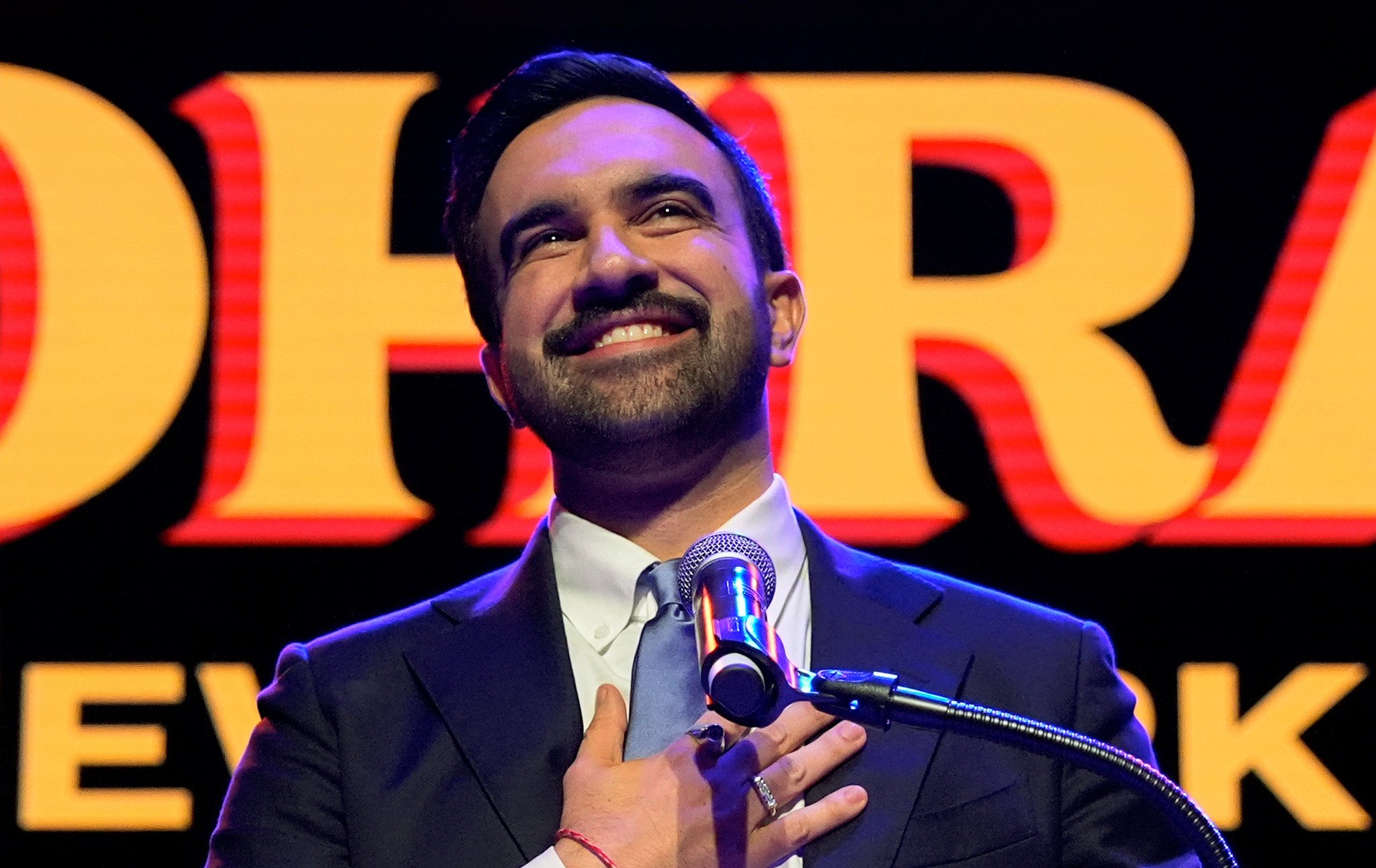
This is how you run. This is how you win. This is the politics we need right now. Democratic socialist candidates can inspire people again, and fight the right effectively.
Watching Zohran Mamdani’s rise has been a strange experience for me. About a year ago, Current Affairs ran an interview with him in our print edition, entitled “Could a Democratic Socialist Mayor Be Just What New York City Needs?” As a socialist, I personally thought the answer to that question was “yes,” but I’m under no illusions about the difficulties leftists face in American politics. Mamdani’s campaign was a huge long shot, and other than Current Affairs, just about the only publications covering the campaign back then were Democracy Now! and Jacobin—who, to their credit, have followed Mamdani’s career from the start.
I was impressed with Mamdani when we spoke—he was relentlessly on-message, constantly coming back to his affordability pitch and giving clear, concise answers that spoke to the basic material needs of New Yorkers. But I’ve had my fair share of excitement followed by crushing disappointment (e.g., the two heartbreaking Bernie Sanders campaigns in 2016 and 2020, Abdul El-Sayed’s 2018 gubernatorial race in Michigan). And so after we turned the tape off, I asked Mamdani to promise me that if he was going to run, and get people like me excited, he would not run a protest campaign but would actually win. “Can you just go and win this thing, please?” He laughed and promised me he would.
And then he did! Of course, I realize it is probably not the case that Mamdani said to himself that day: “Well, if Nathan says I should actually win the election, I guess I have to go and win the election.” But his victory has still been a bit surreal, given that when he confidently told me he would succeed, it seemed incredibly unlikely to actually happen. Then, against all odds, I watched over the months as all of the pieces fell into place, as Mamdani put together a campaign so good that even his sworn enemies now have to admit “he did a better job of speaking to voters’ concerns about their living standards in a city in which what were once basic aspirations like a well-paying job and a decent home to live in have become unrealizable fantasies for many.”
I recently spent a week in New York City, and I saw firsthand a bit of the Mamdani magic. There was the massive rally with Bernie Sanders and Alexandria Ocasio-Cortez in Queens, with more than 10,000 attendees (a huge number for a mayoral event in a non-presidential election year). I couldn’t get into that one, but I did squeeze into a midnight press conference Mamdani gave alongside taxi drivers and nurses, where he spoke about the struggles facing working class people who work nightshifts. (The press conference appeared to have been scheduled at midnight in part to make journalists experience a little of what taxi drivers go through.)
In the course of a whole week in New York, I did not see a single Andrew Cuomo sign. And I looked. Shows of support for democratic socialist (and Democratic Party nominee) Zohran Mamdani, on the other hand, were easily spotted—little smiling Zohrans tucked into shop windows, people on subways with their Zohran buttons. It’s not that the city was abuzz with excitement for the mayor’s race—I didn’t overhear many people talking about the election. (One time I heard a middle-aged Black woman arguing with an older white man in the street, and I thought briefly it was a passionate discussion of mayoral politics, but they turned out to be debating whether it is legal to patent a fungus.) But I did speak with many who were filled with hope for Mamdani—although they also tended to be a little nervous, understanding that the moment he gets into office, he will not only face the combined hostility of the wealthiest people in the city, but also the wrath of the president of the United States, who promised to withhold federal money from New York City if “communist” Mamdani was elected. After the press midnight press conference, an older Black man stuck around to shout over and over “MAMDANI WILL UNITE THE CITY!”
I already wrote about why Mamdani’s campaign has been so refreshing after he won the primary in June, and I don’t want to repeat myself too much. But to recap, he showed the viability of the kind of program that leftists have been arguing for since Bernie ran in 2016: uncompromisingly bold, committed to social democratic policies, focused on economic issues without sacrificing a concern for racial or gender justice, pro-labor, anti-fascist, and delivered in plain language with humor, warmth, and solidarity. Mamdani combined a brilliant video strategy (for which an enormous amount of credit goes to the skilled filmmakers Olivia Becker and Donald Borenstein) with a massive on-the-ground organizing campaign, which aimed to break records for door-knocking. The message discipline, the charisma, the organization—it was enough to impress even crusty Democratic strategist James Carville.
David Sirota of The Lever also pointed out to Current Affairs that Mamdani benefited hugely from New York City’s generous public financing law for elections, which allowed him to focus on organizing instead of fundraising. It’s an advantage that Mamdani himself pointed out in his interview with the magazine:
There are a number of things that give us a pathway to winning, and one of them is the fact that in New York City, there's a public matching system. So if you are a New York City resident, and you give anywhere between $10 to $250 to a candidate running for mayor, the city will match that eight times. And so a $250 donation then becomes north of $2,000 in terms of its worth for a campaign. And what that means is that if you raise around a million dollars, you will then get an additional $7 million or so from the city, enabling you to run an $8 million campaign.
It helped, of course, that Mamdani’s chief opponent, Andrew Cuomo, is cartoonishly loathsome, a serial sexual harasser who seems to radiate contempt for the very city he was running to be the mayor of. Cuomo’s slogan may as well have been “Fuck you, I deserve to rule over you,” and he made an excellent foil. Mamdani couldn’t have asked for a better out-of-touch rich man to run against. (Cuomo actually argued at one point that Mamdani’s $2,300 a month one-bedroom apartment was not expensive enough!) If the establishment had lined up behind a slick, Obama-esque centrist who seemed to actually like New York City, Mamdani would have faced a much more difficult fight. But they didn’t.
Now the question is whether Mamdani can actually govern. If his administration is anything like his campaign, it should be competent, despite his lack of executive experience. I think Mamdani and the people around him are under no illusions about the obstacles they face, and I am sure I don’t need to tell them that FDR should be the model here. Importantly, FDR became wildly popular even as he initially struggled to solve the most important crisis facing the country (the Great Depression), because he stayed in touch with the people, and communicated to them that he was constantly fighting for them. I hope Mamdani doesn’t make the mistake Obama did and disband his organizing apparatus after getting elected, instead continuing to constantly engage and mobilize the public. (In Obama’s case, this was not exactly a “mistake” since it was in part a product of his technocratic ideology.)

The good news is that the history of socialist mayors in the United States shows that they can actually succeed. Socialist Daniel Hoan is considered one of the best mayors in the history of Milwaukee, having focused on rooting out corruption, establishing public buses, and keeping up the quality of city parks and public schools. He didn’t exactly overturn the basic economic order, but he did show that socialist principles are compatible with competent, honest government. Likewise, Bernie Sanders is regarded as having been a capable and effective mayor of Burlington, Vermont.
Mamdani faces an immense challenge now. After ten years of insisting that if handed power, the left can deliver for people, we don’t want to be like “the dog who caught the car.” Many eyes are on Mamdani to see what he will do next, whether he will crash and burn, sell out, or provide evidence that democratic socialism is the politics America needs. If he defies the skeptics and haters, and is the best mayor in the history of New York, delivering on his agenda, Mamdani may massively improve the political fortunes of the American left. If, on the other hand, he disappoints, he may discredit the left, and make it impossible to get socialists elected to office in the future. I hope he and his team know what they are doing—but if they govern as well as they campaigned, New York City is in good hands.
For the last ten years, Current Affairs has been relentlessly making the argument that democratic socialist politics can win, and need to be given a chance. We now have that chance, and it is probably the most exciting moment in the history of the U.S. left. The pressure is on. The fight is just beginning. But this is an incredible victory, and the hard-working New Yorkers who made it possible have a lot to be proud of.