From Congress to cable news to the streets, peddling Islamophobia no longer comes with consequences.
Within the past month alone in New York City, a mugger targeted a Muslim woman on the subway, calling her a “terrorist” and saying that Mayor Zohran Mamdani “can’t help you now”; a man smeared feces on a mosque after tearing pages from the Quran on the doorstep; and a member of a pro-Israel terror group was exposed for planning to assassinate a Palestinian-American woman and movement leader.
Our nerves are frayed. As members of historically excluded communities—including Muslim, Arab, and Palestinian communities—our nerves have long been frayed, and especially so since 2023. And this year has somehow started off worse than last year ended.
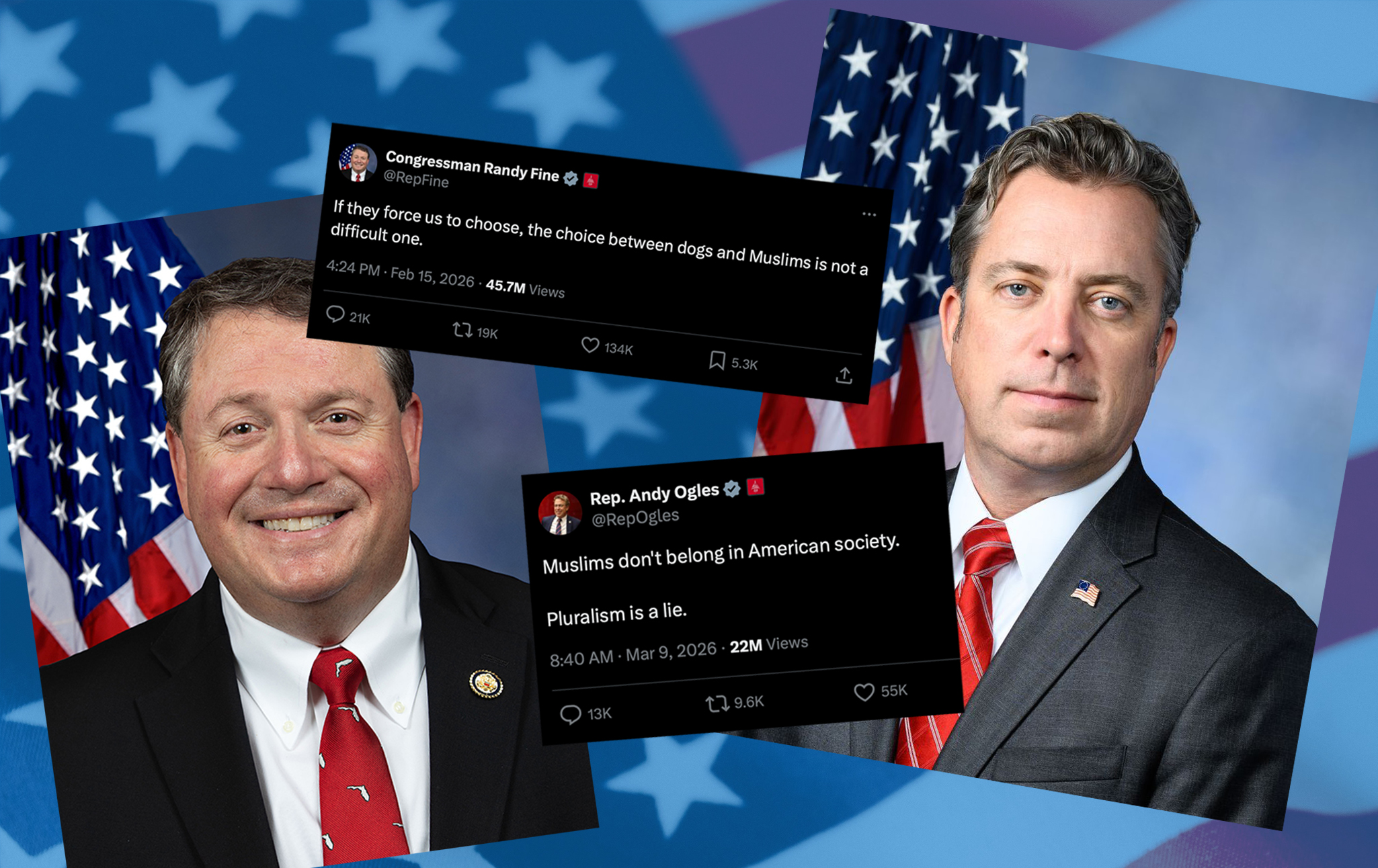
To understand why we feel so unsafe and unwelcome in this moment in particular, one need only listen to the many members of Congress openly hating and endangering American Muslims with no political or professional consequence: Tennessee Rep. Andy Ogles has declared that Muslims “don’t belong in American society” and that “Muslims are unable to assimilate; they all have to go back." Florida Rep. Randy Fine, who has previously called for the mass expulsion of all Muslims from the United States, stated, “the choice between dogs and Muslims is not a difficult one.” As none of these comments have been met with consequences from Republican leadership, this would lead no one to believe that acting on such statements would, either. While the present seething public hatred of Muslims may feel exceptional, it is important to understand its history.
The Backdrop
American Muslims, Arab Americans, and other communities viewed only through the lens of national security have long dealt with being made to feel like guests in our own country. We’re constantly inundated with propaganda telling us we’re not fully American, not fully accepted, while also being criticized for having legitimate grievances with a country and culture that reject us. This is made worse by the impacts of U.S. imperialism on our communities, at home or abroad—impacts that often destroy entire communities and end lives. While our communities are used to being victimized twice by attacks against our families in our homelands and our communities in the United States, this latest wave is different in some important ways. The same politicians spewing hatred against American voters who happen to be Muslim are also voting to fund the genocide in Gaza, the ethnic cleansing of Southern Lebanon, and the war on Iran, and seemingly will face no effective reprimand for any of it.
A recent history of academic discourse seeks to better define “Islamophobia,” with the central question interrogating whether it is a religious prejudice or a form of racism. What comes to light from the research is that racism absolutely plays a role in manifestations of anti-Muslim bigotry, compounding the impact of prejudice. Additionally, the racialization of Muslims in the public’s psyche means non-Muslims are subjected to anti-Muslim hate, too, because of the offender’s perceptions of their victim. Take, for example, the tragic murder of Balbir Singh Sodhi: he is believed to be the first person targeted in a retaliatory attack after 9/11 because he was perceived to be Arab or Muslim. But Sodhi was neither; a practicing Sikh, he’d immigrated to the U.S. from India in 1989. After a deranged racist shot him point-blank on Sep. 15, 2001, neighbors remembered the convenience-store owner for his kindness—handing out free candy to children in the very spot where he’d later be gunned down. Those peddling bigotry and hate don’t care about nuance, and it’s why examinations of anti-Muslim hate include more than the Muslim community alone when speaking about who is impacted.

Given this context, it is no surprise that hate crime statistics and anecdotal evidence have long shown that bigotry against Muslims in the United States, as well as Arabs and other groups perceived to be Muslim, waxes and wanes in rough relation to foreign policy developments.
Arab Americans saw increased repression after the 1967 Naksa (referred to in the West as the Six-Day War), for example, with multiple pro-Palestinian activists finding their phones tapped by the federal government. After the 9/11 attacks and the U.S. invasions of Iraq and Afghanistan, discriminatory policies such as NSEERS and the USA PATRIOT Act enabled law enforcement to arrest over 700 Muslims between Sep. 2001 and Aug. 2002—not a single one of whom was actually linked to terrorism. In some ways, the post-9/11 bigotry spread with relative ease among American society, as many were already primed against Muslims after the 1993 World Trade Center bombing.
More recently, the rise of ISIS in the mid-2010s led to over 200 anti-Sharia law bills being introduced in state legislatures across the country between 2010 and 2018. Of course, there is no record of any state legislator in the United States introducing a bill to implement Sharia as U.S. law. Nonetheless, this manufactured anti-Muslim panic was the backdrop of now President Trump’s 2015 promise to ban Muslims from entering the United States, the same year he lied about seeing American Muslims celebrate the 9/11 attacks.
Of course, the most recent wave of bigotry grew in the wake of Oct. 7, 2023. Israel accelerated its genocide in Gaza and supremacist policies in the West Bank, Syria, and Lebanon, which the Biden administration either supported or failed to effectively oppose. This led to over 12,000 protests across the United States, which were met with historic levels of repression and government surveillance.
Because Palestine is Arab and majority Muslim, many students identifying as such participated in these political expressions of discontent. When names of murdered Palestinians made their way to all of our social media feeds, Palestinians in the diaspora saw those names as our uncles, grandmothers, friends, and children. The secondary trauma lingers. Unsurprisingly, the backlash against those condemning genocide soon followed; in November 2023, President Obama’s former deputy director of the Office of Israel and Palestinian Affairs harassed an Egyptian halal cart vendor on multiple occasions, yelling things like, “If we killed 4,000 Palestinian kids, it wasn’t enough.” The Council on American-Islamic Relations reported a record high 8,658 anti-Muslim and/or anti-Arab discrimination complaints in 2024, likely including an anti-Muslim assault by credentialed participants against a woman in hijab and others at that year’s Democratic National Convention.
It’s important to note that Arab and Muslim voters in the United States strongly preferred Democrats for the two decades between 2004 and 2024, in part because of the Republican-initiated “War on Terror” ravaging Arab and Muslim-majority countries and the stark rhetorical contrast between President Obama and President Trump toward these communities. But in 2024, amid a Democratic administration funded-and-supported genocide, the DNC ignored voters’ demands to end the genocide and proved the party’s total disregard for impacted communities by refusing even the smallest gesture of stage-time to a Palestinian American. The Party lost the confidence of Arab and Muslim voters across the country, including in crucial swing states. This overt anti-Palestinian racism likely cost Vice President Harris the presidency, according to the DNC’s own internal report.
Now politically alienated from both parties, 2025 has kept the bigotry ball rolling against Muslim, Arab, and other communities. Candidates for New York City mayor happily peddled anti-Muslim rhetoric to attack Zohran Mamdani, with Curtis Sliwa claiming that Mamdani supports “global jihad” and Andrew Cuomo agreeing with an assertion that the future mayor would celebrate “another 9/11.” Former Rep. Marjorie Taylor Greene, former Rep. Elise Stefanik, Rep. Nancy Mace, Sen. Kirsten Gillibrand, the late Charlie Kirk, and others all attacked Mamdani based on his religion, connecting him to 9/11, Hamas, and burqas. These ugly attacks were tolerated by our body politic, with no one losing positions or platforms as a result. The message has been well received by elected officials: there will be no concrete consequences by either major political party for engaging in bigotry against Muslims. CAIR reported 8,683 anti-Muslim and anti-Arab complaints in 2025, topping the previous high just the year before.
Despite this fever pitch of discrimination, Zohran Mamdani was elected mayor of New York City, a victory that American Muslims could feel as their own; a political joy many had not felt since the 2018 elections of Rashida Tlaib and Ilhan Omar. Nonetheless, there has been little time to celebrate Mamdani's historic victory last fall. Even within the context of the heightened anti-Muslim hate of the years preceding it, 2026 is off to another historic and deeply dangerous start. This year anti-Muslim bigotry seems to be coming from all angles: guests on CNN, conservative radio hosts, and more. Former Capitol Hill staffer and influential Federalist Society member Mike Davis posted on X/Twitter a poll to his nearly 500,000 followers about Muslims, with 97.5% of the alleged 22,120 voters picking “Deport them all.” Self-styled think tanks, tip lines to report Muslims in your community, grassroots conservative groups, wannabe influentials like Laura Loomer, and the old fashioned white nationalists have made explicit their view that Muslims simply cannot be Americans. Anti-Muslim hate among young college students has surfaced this year, as well, including with a student group chat at Florida International University, the New York Young Republicans, and the Georgetown College Republicans.
History shows that anti-Muslim rhetoric on traditional and social media never stays contained there: amid the genocide in Gaza, Palestinian, Arab, Muslim, and pro-Palestine organizations received frequent threats of violence. White nationalists periodically try to infiltrate American Muslim-majority communities, such as Dearborn, Michigan, holding rallies and burning Qurans in an attempt to spark violence. Meanwhile, students have been expelled or disciplined and employees have been punished or fired for expressing pro-Palestine support. Muslims have been censored online and the government has attempted to remove them from the country. And a six-year-old Palestinian-American boy, Wadea Al-Fayoume, was murdered by his landlord in an anti-Muslim and anti-Palestinian hate crime in retaliation for October 7.
In the violent context of the past few years, Ramadan and Eid in 2026 were tense again for much of the community: for American Muslims, ICE raids and the US-Israel war on Iran have heightened the fear of violence from either their government or their neighbors. And this Ramadan was not without violence: an Imam in Utah was shot at, a mosque in Pennsylvania was riddled with bullets, and children were assaulted outside a mosque in Arizona.

Perhaps most damaging for the community’s long-term security is how strongly hatred of Muslims has been embraced in politics in 2026. State and local government officials in Texas (especially Texas), Florida, and Alabama, among others, have wielded their power and influence to discriminate against Islamic institutions. By now it has been well-documented that Rep. Andy Ogles, Rep. Randy Fine, Rep, Derrick Van Orden, Rep. Brandon Gill, and Sen. Tommy Tuberville have all spouted dangerous anti-Muslim rhetoric this year. Not only did Speaker Johnson not condemn their rhetoric, he seemingly rationalized it, saying, “the demand to impose sharia law in America is a serious problem” in response. Separately, he asserted that Iranians follow a “misguided religion.”
This is not isolated: nearly 50 Republicans have joined the Congressional “Sharia Free America Caucus,” which they created only a few months ago. Again, there is no record that any member of Congress or state legislator in the United States has ever introduced a bill to implement sharia within U.S. law. Of course, in contemporary politics there is no reason to let facts get in the way of demonizing a group of people who constitute only about one percent of the U.S. population, especially when hatred of others and manufactured culture wars are incentivized in politics and hardly result in electoral consequences within a gerrymandered system. Only three months in, and 2026 has been a fever pitch of anti-Muslim politics, with no signs of stopping as we barrel toward a consequential midterm election.
The Reason
We arrived at our current anti-Muslim fever pitch via a perfect storm of elite political decisions, legal structures, social changes, and latent bigotry ready to be activated. Take, for example, the remarks of President George W. Bush a week after 9/11. The former president sounds more like what we in 2026 would expect from Zohran Mamdani than he does the Speaker of the House from his own party, Mike Johnson.
“Islam is peace[…] America counts millions of Muslims amongst our citizens, and Muslims make an incredibly valuable contribution to our country. Muslims are doctors, lawyers, law professors, members of the military, entrepreneurs, shopkeepers, moms and dads[…]”
And yet, Bush’s words standing stark contradiction to the violent imperialist policy his administration inflicted on Muslims: catastrophic and illegal wars abroad, a torture program at GTMO and blacksites around the world, and deeply discriminatory surveillance policies in the United States. Still, it is difficult to imagine anyone in the current top five spots of the presidential order of succession saying what Bush did 25 years ago.
Since then, the rhetoric of the political arena has changed drastically—largely because in 2008 Americans had the audacity to elect a Black president with an Arabic middle name, as U.S.-led wars continued to demonize Arabs and Muslims. President Obama was accused of being a foreign-born Muslim, and even fellow presidential candidate John McCain’s attempted “defense” against accusations of Obama’s foreignness saw him declare Obama a “decent man” instead of him being an Arab. After Obama’s election we saw the rise of the Tea Party and increased xenophobia in reaction to the perception of a rapidly diversifying country. This was the context in which Donald Trump first descended on that escalator in 2015, symbolically bringing our political discourse down with him. The Supreme Court had a role, too: its decisions in Citizens United (2010), Shelby County (2013), McCutcheon (2014), and Rucho (2019) have left our political landscape corrupt, unequal, polarized, opaque, and deeply undemocratic. Overt authoritarianism is now an identifiable concern for many in the United States.
President Trump has made use of this new legal and political climate and his dominance of the Republican Party since his 2016 victory. His efforts to ban Muslims and denigrate the populations of countries with Black and brown majorities has given new permissions and have shown new avenues of political success for previously shunned, closested, or frustrated xenophobes and bigots across the country. Bigoted voices who may have felt discouraged by the rhetoric of George W. Bush or Barack Obama now feel emboldened by the rhetoric of Donald Trump, who has been proven to put his most extreme words into action.
With this normalization, recently anti-Muslim statements of hate have generally been met by little condemnation from party leaders or colleagues. The exception is a few Democrats who are willing to post statements of disgust but have not seriously mobilized to disrupt the pattern of rhetorical hate soon to be reflected in policy. Notably, at least a dozen moderate Democrats have been quick to condemn evidence-based comments against Israel from their own Muslim party members, Rep. Ilhan Omar and Rep. Rashida Tlaib, but have thus far been silent on the recent anti-Muslim bile spewing from Reps. Ogles and Fine. Here, they offer their caucus members no protection from bigotry and replicate the painful double standards that American Muslims face on a daily basis. Anti-Muslim bigotry is alive and well on both sides of the aisle as it serves the political interests of both parties.
As for the Republican members of Congress spouting bigotry, there is seemingly little pressure coming from Republican voters to condemn “Islamophobia.” In a poll released in December 2025, the Manhattan Institute found that 57 percent of the current GOP views migrants from Arab and Muslim-majority countries as having benefited from coming to the United States without doing enough to assimilate.According to the study, “Four in ten members of the Current GOP believe that most or all Arab or Muslim Americans have greater loyalty to a foreign country than to the United States. For every other group, no more than three in ten believe that most or all members are more loyal elsewhere.” If Republican voters are primed to distrust Arabs and Muslims, and Republican leadership is actively participating in their vilification, why wouldn’t Members of Congress attack them in hopes of squeezing a few more votes or donations from their highly gerrymandered districts going into an otherwise tough midterm election?
And so, in a shallow sense, Muslims, along with Arabs and anyone perceived by bigots to be either, are the political scapegoat necessary in this moment to mobilize xenophobic voters. At other times, efforts to weaponize hate have focused on trans women, DEI, undocumented migrants, Black Lives Matter, “wokeness,” sharia, birtherism, refugees, secularism, political correctness, etc. Whatever group or manufactured culture war front that helps with fearmongering and leads to political mobilization will be embraced in order to drive negative partisanship at the ballot box.
In a deeper sense, though, our current post-2023 climate is exposing multiple structural aspects of anti-Muslim bigotry simultaneously. The genocide of Palestinians in Gaza has exposed how the United States is deeply hypocritical in applying international law and domestic law when victims are Arab or Muslim, and especially when they’re Palestinian. The anti-genocide protests exposed the surveillance infrastructure of the Department of Homeland Security (DHS) and biases of local police departments that regularly train in Israel. Mamdani’s rise exposed how a Muslim candidate’s religion is fair game to attack without repercussion, while any other religion would not be. The War on Iran has made explicit the anti-Muslim hate that has long been used to manufacture consent for deadly U.S. imperialism.
And so, it should be clear by now that the United States does not have a bigotry problem primarily because of the ignorance of individuals—it has one because powerful people and institutions benefit from it. As such, the short-term response in this current political system would be pushback: regardless of party, no elected official who peddles in anti-Muslim hate should be successful again at the ballot box. However, in a system in which over 80 percent of House seats are structurally safe due to gerrymandering, electoral consequences can be difficult. There remains the option of boycotting corporations and organizations which donate to anti-Muslim candidates, as well. Above all, we each have a responsibility to keep talking about Palestine and other grave violations of human rights and international law, especially when perpetrated by those who will otherwise not be held accountable.
But more fundamentally, rhetorical and individual expressions of anti-Muslim hate, and racism more broadly, are grounded in the bigotry found within our laws and institutions. The same policies that enable war abroad, surveillance at home, and unequal application of law are the ones that allow and benefit from anti-Muslim hate flourishing openly. Only by dismantling those foundational causes of structural discrimination and racism can we ensure that this current wave of open hatred of Muslims will be the last cycle, and not merely shelved until it proves useful again.