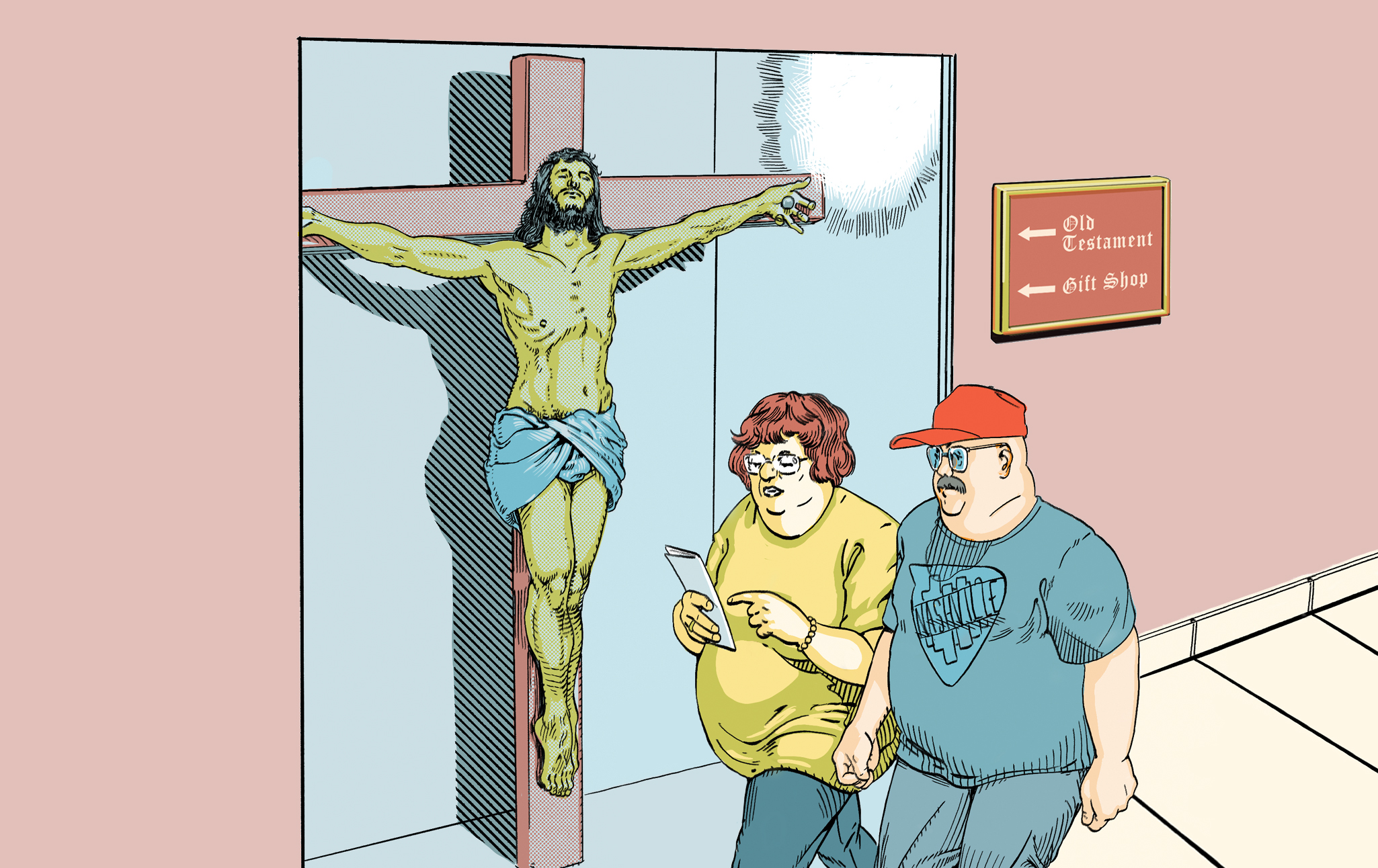
Today’s evangelical Christians are more interested in Old Testament fire and brimstone, and political power, than anything Christ might have said.
One gloomy afternoon last winter, I visited the Museum of the Bible. The institution occupies an impressive six-story brick building, formerly home of the Terminal Refrigerating & Warehousing Company, just a few blocks north of where I live in Washington, D.C. It’s close enough to walk, so I did, a decision I came to regret when the light mist in the air turned into a steady drizzle. Still, approaching on foot, I was able to experience the full effect of what the museum calls its “entrance portals”: two massive bronze facades embossed with Latin text which flank the front door.
The Museum of the Bible opened in 2017, so it’s a recent entry in D.C.’s expansive roster of museums. Most of the funding came from Hobby Lobby, an arts and crafts store chain owned by the Greens, an evangelical family with an Indiana-Jones-villain penchant for stolen antiquities. (For those unfamiliar with this bizarre tale, Hobby Lobby got in serious trouble in the mid-2010s for trafficking black market cuneiform tablets. Hobby Lobby also collects rare books, some of which I saw on display at the museum—but more on that later.)
I didn’t brave the Museum of the Bible alone. I went with my girlfriend at the time, at the invitation of two of her friends, a married couple. We made an odd group: a communist, a secular libertarian, and a pair of high-achieving adult converts to evangelical Christianity. This was not the other couple’s first visit, but it was ours, and I was taken aback when the cashier informed me that tickets cost $30 per person. As I tapped my credit card, I worried that a portion of my money would support the persecution of sexual minorities in a distant part of the world. But, I rationalized, I also eat at Chick-fil-A from time to time, and that doesn’t teach me anything about the Bible.
Nor, as it turned out, did the museum. The main attraction is an exhibit on the third floor. Actually, it’s not an “exhibit” so much as an audio-visual spectacle in several parts. We started with the Old Testament section. Along with a crowd of about 20 other visitors, we wandered through a series of rooms, each of which had a different Bible-themed display. Most of these displays were accompanied by an animation of the relevant biblical events projected onto the wall, and several were augmented by smoke and flashing lights. In my favorite moment, we walked down a dark hallway toward an illuminated shrub, which suddenly burst into flames.

We were guided on our journey by a stern voice that seemed to come from all around us. Speaking in a vaguely Middle-Eastern accent, the voice narrated the key events of the Old Testament: the creation of the world, the Garden of Eden and man’s fall from grace, Cain and Abel, the flood, the ascension of King David, the Jews’ captivity in Egypt and their escape under the direction of Moses. I’m no Bible scholar, so I can’t comment on the overall accuracy of the exhibit’s rendering of these stories. But there was one omission that struck me as noteworthy. Recounting the book of Exodus, the narrator described how Moses urged the Egyptian Pharaoh to let his people go, and how the Pharaoh stubbornly refused. In this telling, it’s the Pharaoh’s pride and greed that prevent him from acceding to Moses’s demand for freedom, even as the plagues continue to multiply. In the book of Exodus, though, it is God who prevents the Pharaoh from yielding so that He can demonstrate His power to the Egyptian people. Here’s what God says in Exodus 7:3–5, the King James version: “And I will harden Pharaoh’s heart, and multiply my signs and my wonders in the lands of Egypt. But Pharaoh shall not hearken unto you, that I may lay my hand upon Egypt… [a]nd the Egyptians shall know that I am the Lord...”
The sequence of plagues culminates in the Passover, when God kills the firstborn son of each Egyptian household but “passes over” the Jewish children. A few years ago, I attended a Passover Seder for the first time. A Seder is a traditional Jewish ceremony for celebrating Passover, but the content can vary from household to household, and hosts can personalize the ceremony to reflect their own views and priorities. At the Seder I attended, I was touched when the host dedicated a segment of the proceedings to the Egyptian children who fell victim to the final plague. To acknowledge the suffering of the oppressor was, I thought, a remarkably humane sentiment.
Needless to say, the exhibit expressed no such misgivings. Indeed, the omission of God’s role in the Pharaoh’s intransigence seemed to reflect the mission of the exhibit as a whole: to smooth down the Old Testament’s rough edges, eliminating anything difficult or ambiguous and leaving only black-and-white certainty. The exhibit presents each of God’s actions as a measured response to human evil, one that accords not just with divine justice, but human justice too. And the exhibit skips or glosses over any portions of the Old Testament that might support alternative interpretations. For instance, there’s no mention of Saul, the erstwhile first king of Israel who disobeyed God’s command to kill every member of a defeated tribe and later committed suicide after losing a battle. Instead, the exhibit implies that the more obedient David was the first king. Neither the book of Job, which questions whether the justice of God is comprehensible in human terms, nor the book of Ecclesiastes, which is a sort of proto-existentialist musing on the purpose of life in an ephemeral world, make an appearance. All is right with the world, the exhibit seemed to say, the sun rises only on the just and the rains come only to the unjust.
As we neared the end of this segment of the exhibit, I was reminded of Reading Genesis, a truly execrable nonfiction book by the novelist and academic Marilynne Robinson. Reading Genesis offers a more intellectually rigorous version of the exhibit’s mission—that is, a full-throated defense of the Old Testament to modern readers who might have qualms about all the rape and murder. Robinson recognizes that there is simply no way to square the Old Testament with universal moral principles; when God isn’t slaughtering people Himself, He’s allowing (or commanding) others to do so.
-png.png?width=2550&height=3300&name=Current%20affairs%20bible%20museum%20(1)-png.png)
Art by Ben Clarkson from Current Affairs Magazine, Issue 57, November-December 2025
Instead, she characterizes the Old Testament as a story about God’s faithfulness to His chosen people despite their transgressions. “The idea that God would make concessions to these most regrettable human propensities might seem at odds with the righteousness and the compassion that are his preeminent attributes,” she writes, demonstrating a penchant for understatement. “It is consistent, however, with there being a series of covenants, and the promise of new covenants, to establish terms on which God and humankind can reach some kind of peace and mutual enjoyment.” But elsewhere, Robinson makes clear that “humankind” doesn’t mean humans generally. She discusses, for example, the massacre of a city called Shechem by Jacob’s sons, a story she concedes “seem[s] far too ugly to be in the Bible.” “Yet,” she points out, “God does not treat the covenant as violated. Jacob and his sons remain under His protection.” She explains this discrepancy by arguing that “this narrative concerns itself with the singular history of a chosen people…” God, in other words, cares about the fate of a particular lineage—and members of that lineage are free to massacre those lacking God’s protection.
Of course, this doesn’t hold water either. It doesn’t explain, for example, why God allowed His people to suffer slavery in Egypt, or why He decided a genocide of the Egyptians was necessary to resolve the situation. Still, I wondered whether Reading Genesis and the exhibit were versions of the same strand of thinking, a new kind of Old Testament apologia. I wondered, too, whether this thinking signaled broader intellectual currents in the resurgent evangelical right.
All this wondering left a bad taste in my mouth, and I was relieved when we made the transition to the New Testament portion of the exhibit. Since the museum is funded by organizations that purport to advance Christian values, you’d think the New Testament would receive the most attention. But in fact, it’s sort of a letdown. There’s no omnipresent voice and no pyrotechnics. Instead, visitors watch two short videos. The first is a five-minute introduction to the figure of Jesus. We caught only the tail end of that one; though, as my girlfriend joked, that didn’t stop us from appreciating the rest of the exhibit. “After all, we know who He is.”
The second is a dramatization of Luke 24:13–25, which lasts about a half hour. In the museum’s version of this tale, two men, Cleopas and Nathaniel, are traveling from Jerusalem shortly after Jesus’s crucifixion. Cleopas, something of a cynic, argues that Jesus’s death disproves His divinity; Nathaniel disagrees. An unknown traveler joins the pair on the road, and, as they walk, gently admonishes Cleopas for his lack of faith. Cleopas eventually invites Nathaniel and the traveler to pass the night in his house. The house is deserted, and Cleopas reveals that his wife left him, taking their daughter with her, after discovering that Cleopas had an affair. (I wondered where she went: Holiday Inn Jerusalem?) “I would give anything to get them back,” Cleopas says, a line that might just as easily be heard near the end of a Netflix rom-com.
The traveler, who is obviously Jesus in disguise, comforts Cleopas with a somewhat muddled parable about faith and sacrifice. Then He reveals his identity to the astonished pair and promptly vanishes—leaving behind a wooden figurine of a dog He has carved for Cleopas’s daughter. Of course, the filmmakers simply invented most of this plot—the relevant verse of Luke mentions a guy named Cleopas who encounters Jesus after His death, but the focus of the verse, sensibly enough, is on Jesus rather than Cleopas’s family life. The whole thing amounts to little more than Bible fan-fiction.
The anachronistic Cleopas subplot, coupled with the low production values and Hallmark-movie acting, made for an odd viewing experience. But there was something odder still about the film, something I didn’t quite grasp until after we left. Jesus’s role in the whole thing was bizarrely minimized. The bulk of the New Testament exhibit was a film showing events after Jesus died. The film alludes to the crucifixion only in passing, and there’s no mention of anything Jesus might have said or stood for. No Sermon on the Mount, no healing of the sick, no casting the money-lenders from the temple. Jesus appears only as an apparition, and when he remonstrates with Cleopas, he talks about Cleopas’s family drama, not broader spiritual issues. Though Jesus counsels Cleopas and Nathaniel to keep the faith, the film seems completely uninterested in the follow-up question: faith in what?
But the museum’s answer to that question became clear to me over the rest of our visit. As I emerged from the dark theater and stood blinking in the bright fluorescent lights, one of our party suggested that we ascend to the fourth floor. There, we found ourselves in a circular room, surrounded by many thousands of Bibles lining the walls. Scanning the room, I quickly understood what was remarkable about this display—each Bible was in a different language. There were also several sections with “placeholders” for languages into which the Bible has not been translated, mostly dead and dying tongues with few living speakers, plus a handful spoken only in places where Christianity is outlawed. That little room embodied an ambition of jaw-dropping scale: to ensure that there is no language which lacks Christianity’s sacred texts. Of course, that ambition carries with it the vestiges of colonial hubris. How many untold thousands, I wondered, have died as a consequence of the West’s efforts to convert them?
After a few minutes in the translation room, I followed the group into a larger exhibition next door, which featured rare and ancient Bible printings from around the world. (Remember what I said about Hobby Lobby’s collection of antiquities?) My favorite was a huge early-Renaissance tome, each page of which featured the same passage in four different languages. I imagined a nameless monk painstakingly assembling four varieties of movable type in a crude printing press—a labor of love I couldn’t help but admire.
And at that moment, I realized what the museum believes in. What lies at the heart of these exhibits is not anything the Bible says. Instead, the museum invites faith in the Bible itself, the text divorced from its content, as the embodiment of Christianity’s cultural scope and material power. In a twist worthy of Baudrillard, the signifier has replaced anything it might conceivably signify.
Of course, this is tough to reconcile with any fair reading of Jesus’s actual message. As the New Testament gospels tell it, Jesus defied the religious authorities of his day, urging revelation and personal spirituality over tradition and authority. But that very inconsistency undergirds the museum’s fixation with the Old Testament. One standard Christian explanation for the apparent disparities between the Old and New Testaments—why “an eye for an eye” gives way to “turn the other cheek”—is that Jesus’s death and resurrection sealed a new covenant between God and mankind. That’s why most Christians don’t feel themselves bound by Leviticus’s detailed dietary restrictions or Deuteronomy’s prohibition against mixed fabrics. But Reading Genesis and the Museum of the Bible eschew this explanation. They instead present the Old and New Testaments as an uninterrupted continuity. And the clear implication, at least at the Museum of the Bible, is that when the two conflict, the values of the Old Testament should triumph.
This fixation with the Old Testament permeates other cultural artifacts of evangelical Christianity as well. Consider, for example, the “Ark Encounter,” a to-scale replica of Noah’s ark in Williamstown, Kentucky, and the nearby Creation Museum. Though both attractions are run by evangelical Christian organizations, neither has much to say about Jesus. The purpose of the Ark Encounter is evidently to convince the public that the story of Noah's ark—in which Noah builds a boat that fits a male and female member of each of Earth’s ten million species—is plausible as an account of the world’s history. Similarly, the Creation Museum is not so much a museum as a sequence of graphical renderings of events depicted in the Bible, accompanied by simple text blurbs advocating a creationist viewpoint. Unlike these attractions, the Museum of the Bible is a real museum—it features actual exhibitions of historically significant items, accompanied by at least a modicum of bona fide scholarship. But all three entities share the same basic purpose: to convince the public that the story and values of the Old Testament are basically correct.
Perhaps that conviction helps to explain the evangelical right’s overwhelming support for Donald Trump, the least Christian person to walk the earth since Anton LaVey. In the aftermath of Trump’s win in 2016, pundits suggested that abortion was a “major factor” in evangelicals’ political behavior. The religious right held their noses and voted for Trump, according to this theory, because they believed the evil of abortion outweighed anything else Trump had done or might do. Then they got what they wanted—a Supreme Court loaded with Trump judges overturned Roe v. Wade. But evangelical support for Trump didn’t abate once that longstanding goal was accomplished. Eighty percent of self-declared evangelicals voted for Trump in 2024, approximately the same fraction as supported him in 2016 and 2020. Some evangelical groups have doubtless glommed on to other issues, like gay marriage, to justify their continued support for Trump. But more fundamentally, Trump seems to embody the way they actually view the world.
NPR’s interview with Russell Moore, formerly a top official in the Southern Baptist Convention, offers a clue in interpreting these trends. Back in 2023, Moore reported that an increasing number of evangelicals were rejecting Jesus’s message as such. He recounted an instance of an evangelical pastor who received pushback from his flock when he tried to highlight the peaceful and tolerant aspects of Jesus’s message in a sermon. The congregant accused the pastor of spreading liberal talking points. “I’m literally quoting Jesus Christ,” the pastor said. “Yes, but that doesn’t work anymore. That’s weak,” the congregant replied.
Vice President JD Vance seemingly agrees. In a Fox News interview from early 2025, Vance, who recently converted to Catholicism because “the Catholic Church [i]s just really old,” invoked the medieval Catholic doctrine of ordo amoris, or “order of love,” to suggest that our obligations to our fellow humans fall into a strict hierarchy. “We should love our family first, then our neighbors, then love our community, then our country, and only then consider the interests of the rest of the world,” he said. Never mind that Jesus, when asked to interrupt a sermon to speak to his mother and brothers, asked “Who is my mother? and who are my brethren?”—then pointed to his disciples and said “Behold my mother and my brethren!” And never mind that when a lawyer asked Jesus “Who is my neighbor?”, Jesus responded with the parable of the Good Samaritan—in front of an audience whose members would have been highly unlikely to regard Samaritans as their neighbors.
Of course, dissonance between Jesus’s message and evangelical Christians’ actions is nothing new. Many of the most successful televangelists promote what's called “prosperity theology,” which holds that believers who are sufficiently holy and faithful will enjoy material riches on Earth. (They must not have read Matthew 19:21, where Jesus commands a follower to “sell that thou hast, and give to the poor, and thou shalt have treasure in heaven.”) It’s no surprise that many prominent adherents of prosperity theology, like Kenneth Copeland—who became infamous in the early days of COVID for claiming he could cure the disease by blowing the “wind of God” on his congregants—are closely associated with Trump.
So if these so-called Christians don’t believe in Jesus anymore, what do they believe in? According to the growing number of evangelicals who identify as “cultural Christians,” the essence of Christianity is not anything Jesus said or did, but the traditions and social identity of a specific Christian community. Elon Musk, an atheist through-and-through, recently adopted the badge of “cultural Christian” and announced he was a “big believer in the principles of Christianity”—which, he said, justified his decision to cut off his gender-nonconforming daughter. Given that Musk is an obsessive pro-natalist who has fathered a brood of children with many different mothers, the “principles” he’s talking about likely boil down to Christianity’s traditional encouragement of procreation. The idea of “cultural Christianity” has gained purchase in mainstream conservative politics too. Vice President Vance echoed these ideas of tradition and community when he laid out his vision of America at the 2024 Republican National Convention. “America,” he said, “is not just an idea. It is a group of people with a shared history and a common future. It is, in short, a nation.”

All of this is, of course, perfectly consistent with Trump’s own instincts and worldview. In September 2025, Trump himself visited the Museum of the Bible, where he gave a typically grandiloquent and rambling speech. In one segment of the speech, Trump boasted about his deployment of the National Guard to patrol the streets of D.C. and claimed he had reduced crime by more than 87 percent. Then he complained that he couldn’t “claim 100 percent” because “things that take place in the home, they call ‘crime.’ They’ll do anything they can to find something. If a man has a little fight with the wife, they say, ‘This was a crime.’” Talk about an Old Testament idea.
Thus, it’s no surprise that the thought leaders of “cultural Christianity” are rediscovering the Old Testament. The New Testament promises salvation to sinners and the righteous alike, and extends its vision to all the world’s peoples. Most of the stories in the Old Testament, by contrast, feature an in-group and an out-group, and almost all those stories end with the out-group losing—sometimes at the cost of all its first-born sons. These are tales of a cohesive group of people protected by a wrathful god against a mostly hostile world. Needless to say, this is a much more congenial worldview for a cultural movement obsessed with evil outsiders and haunted by delusions of persecution.
After a few hours at the museum, I was ready to return to the secular world. I bade farewell to the collection of ancient Bibles and meandered outside into a wintry evening. But what I’d seen stayed with me, and I pondered its meaning on my walk home. As I shivered in the cold, a vision of the future of evangelical Christianity formed in my mind. Jesus, with His lefty egalitarianism and woke calls for acceptance and forgiveness, was out; Yahweh, the vengeful and ethnocentric deity of the Old Testament, was back in. God help us all.