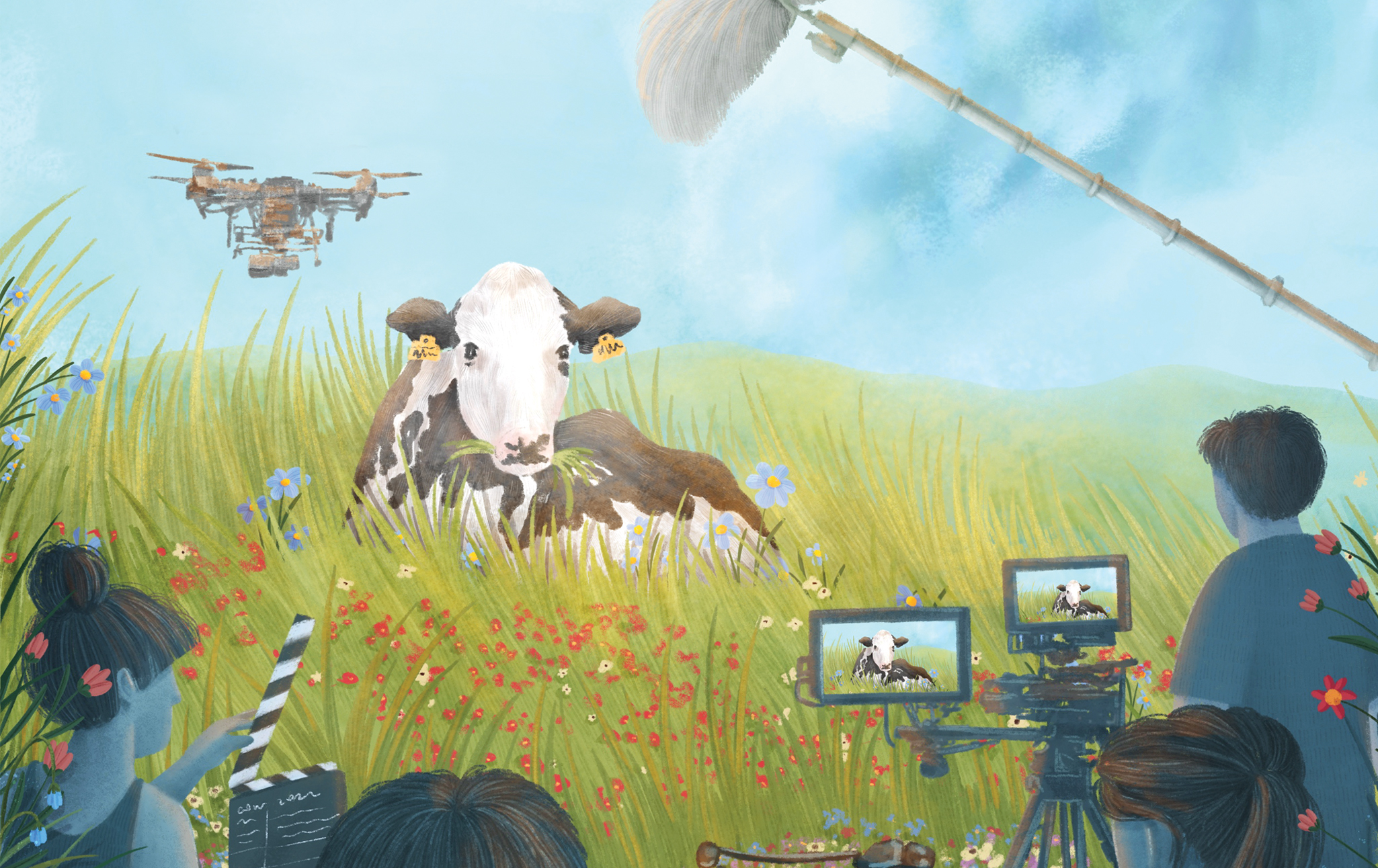
By showing the lives of cows on their own terms, Arnold’s 2021 film reveals the depth of the dairy industry’s violence.
Andrea Arnold’s 2021 film Cow is, ostensibly, a documentary about a dairy cow. But it offers an experience unlike any other documentary I have watched. Shot over four years on a dairy farm in Kent, England, its portrayal of a cow’s life eschews the reassuring framework of the human perspective. There is no narration, no talking heads, no facts and figures guiding us—yet it doesn’t feel like it’s just a typical animal documentary that has had those elements subtracted. It feels like a fictional film starring animal actors. It feels like a cinema verité documentary that a cow would make for other cows. The few humans who appear onscreen are insignificant, transient, and above all distant. The cow is our constant. “It’s not really a documentary. I don’t think it is. I don’t know what it is, but it’s not a documentary,” Arnold said in an interview with the Playlist, before admitting, “I don’t know why it’s not… What is a documentary, maybe?”
Before it can be anything else, film is a sensory experience. Few filmmakers make me feel this as acutely as Andrea Arnold, who renders environments so vividly that I remember them in tastes and textures as much as images, in ambient sounds as much as dialogue. Plants that crack through concrete, potholes big enough that rain turns them into ponds, the tinny sound of a pop song in someone else’s headphones. The crunch of leaves and squelch of mud and taste of cotton in the heathery moors of her adaptation of Wuthering Heights, and the cold, too-wet stickiness of the pork ribs thrown on the ground and scavenged by the hungry children in her Oscar-winning short film Wasp.
Arnold’s environments are not just urban or rural, but often a third kind of space: not the cleanly partitioned suburbs, but the liminal spaces in which city and country blur together, exposing the falseness of the urban/rural dichotomy. This reflects her own upbringing. Raised by a young single mother in public housing in Kent, her childhood was full of curious juxtapositions of post-industrial decay and pre-agricultural wilderness. She would wander between “estates and chalk pits and deserted old industrial spaces and woods and motorways,” she wrote for the Guardian. “Out of this grew a deep love of insects and birds and animals and plants. Stray estate dogs, the Traveller ponies chained by the motorway, the fish and frogs in the water-filled bomb site, wild strawberries on the banks of the chalk pits. I can conjure up these places vividly now. The smells and sounds and feels and colors.”
Arnold is one of the great chroniclers of working-class woman- and girlhood, like a social-realist counterpoint to Sofia Coppola’s gilded cage movies. As Ian Christie writes for Criterion, Arnold’s films often “center on young women living in housing projects and facing sexually fraught situations.” You would expect Cow to stand apart from other work in this regard, but it feels deeply embedded in the same themes and ways of seeing. Even its title smacks of a vulgar, English misogyny: in British English, “cow” is a demeaning epithet for a woman who’s abrasive, mean, or conceited.

We’re introduced to Luma, Cow’s titular protagonist, as she gives birth, human hands easing the calf out by the hooves. As the calf lays in the hay, coated in amniotic fluid and blood, Luma carefully, diligently licks her newborn clean. The calf stumbles to their feet and sucks at Luma’s teat. And then they are separated: Luma is corralled in one direction, her offspring in another, never to see each other again. The placenta is hanging from Luma’s backside, afterbirth still in progress. She cries out—a mooing that doesn’t sound intrinsically like distress, but in repetition, feels like a demand to see her baby. She stares down the camera lens with her big, black eyes. Then she is pulled off somewhere else, to be hooked up to a milking machine. A top 40 radio station echoes around her, because to the humans that pick the music, it’s just another day at the office.
Arnold and director of photography Magda Kowalczyk shoot Cow from Luma’s eye level. Like the kid’s-level shots in ET, it makes the viewer see the world as its characters see it, to identify and empathize with their point of view. Doing this with kids is one thing—not only has everyone had personal relationships with children, but we’ve all been children—but achieving the same effect with a cow, an animal that most people have probably not even seen up close, is a stunning testament to Roger Ebert’s description of the movies as a machine that generates empathy. Cow doesn’t anthropomorphize Luma: the distinctness of her features, the force of her personality, her rich emotional life, none of this is in contention with her emphatic cowness. The film individuates her without the need to make her seem more human. Instead, it reveals that some of the qualities we imagine as uniquely, definitionally human are in cows, too. Her eyes are so unhuman—big and black and shiny—and achingly soulful. “I just wanted to show you her consciousness,” Arnold told Vulture, “I wanted to show the character and the aliveness of a nonhuman animal. I wanted to see if we could see that.”
The cows are constantly being moved from here to there, but we often don’t understand why. We’re experiencing the cows’ perspective, and it’s just the push and pull of a force of nature, as far as the cow knows. Snatches of human dialogue throughout are contextless chit-chat, like we’re sitting just outside a circle of people who all already know each other. At one point, two farm workers describe Luma’s increasing protectiveness, often coming out as aggression: “She never used to be… This is her sixth. Last year she put me out of the pen. That wasn’t even her calf either. Old age, she’s got protective. That’s what happens.” It’s casual, and in some ways, obvious: dairy cows regularly give birth so they can continue to produce milk. (Luma’s udders are so swollen and distended with milk that, by the end of the film, she has difficulty walking.) But Luma’s separation from her calf was devastating enough before finding out it was her sixth pregnancy. Five babies had been taken from her before the film started, and she hadn’t gotten used to it, hadn’t adjusted to a new normal, had just gotten angrier, more protective of calves that aren’t even hers.
Cow is not a grisly exposé of factory farming or a didactic piece of vegan agitprop. It takes a clear-eyed, observational approach, and that is precisely why it is one of the most harrowing, upsetting films I’ve ever seen. It presents a reality that we know to be true but which most of us, most of the time, choose not to see. As with so many things, it’s easier not to have to think about it.

In his essay “Why Look at Animals?,” art critic John Berger describes a shift in how animals are conceptualized in human culture. The mainstream view once saw animals as majestic and mysterious secret keepers: human and animal, both alike and unalike, can observe one another, but only across an impassable abyss. Animals contained an existential duality: “They were subjected and worshipped, bred and sacrificed.” By the 19th century, this shifted in favor of viewing animals as essentially mechanical. A more tender stance towards animals no longer spoke of their unknowable wisdom, but their supposed innocence. This shift in attitudes happened in parallel with a shift in lifestyle, as humans in the city of the Industrial Revolution moved from living with and among animals to living separate from them.
Cow feels rooted in this earlier way of understanding animals. We look at Luma and recognize her; she looks back at us. We understand her in many ways, but she is in other ways unknowable. She is one particular cow with a specific experience, and the archetypical cow, standing for a billion others. It is painful to watch her calf be taken from her, and I pour her milk over my breakfast cereal in the morning.
“A peasant becomes fond of his pig and is glad to salt away its pork,” Berger writes, “What is significant, and is so difficult for the urban stranger to understand, is that the two statements are connected by an and and not by a but.” Us “urban strangers” must either learn to understand the and, or morally reckon with the contradiction that necessitates a but. Luma doesn’t have a bad life for a cow: she feeds on grass out in the fields, she mates naturally with a bull in seemingly pleasant circumstances rather than being subjected to artificial insemination, and the farm workers are both warm and professional. She is not abused or hurt. And yet—with zero emotive music cues or leading narration—Cow is a heart-wrenching, hard watch. It says, this is where your dairy comes from. You don’t need prompting to ask yourself, is it worth it?