Kenny Hill walked away from his extraordinary sculpture garden 26 years ago. Today, the Louisiana community that saved it is fighting their own battle against disappearance.
Somewhere in a patch of grass along the South Louisiana bayou, amongst cement angels and cowboys, 38-year-old Andrew Cuneo leans down to greet an old friend. Well, a statue of him, anyway.
“This one’s my favorite,” Cuneo says, slinging an arm around the life-size sculpture. “This is how I remember him.”
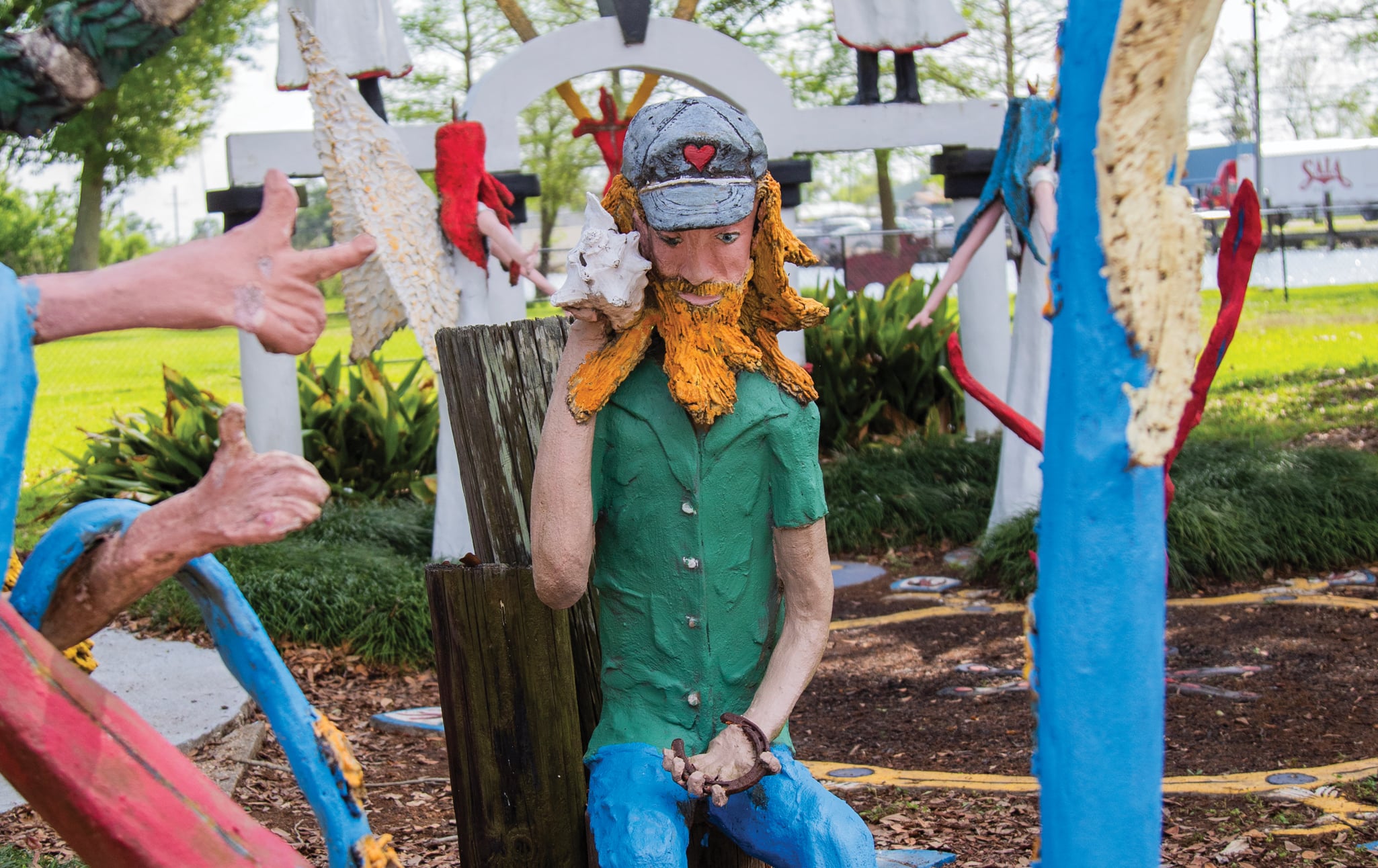
In memory and in plaster, artist Kenny Hill hasn’t aged a day in 26 years. His hair, shaggy and blond, tucked into a blue trucker hat, sits permanently below his shoulders. In one frozen hand, he holds a conch shell up to his ear like a telephone. The self-portrait statue is one of dozens that make up Chauvin Sculpture Garden—regarded as one of America’s most unique folk art destinations, both for its scale and the enduring mystery of its creator.
Back when Kenny built this place, it was simply his front yard. As far as anyone knows, he has never opened the waist-high fence that now surrounds his statues, which once emerged from the foliage as if they’d been planted. He’s never read the plaque that now sits at the garden’s entrance, listing the few known details about his background. He’s never once attended the yearly festival celebrating his life’s work, where visitors buy T-shirts bearing his name and pose for photos within his sprawling installation.
That’s because one afternoon in early January 2000, upon discovering an eviction notice taped to the door of his wooden shack, Hill packed a knapsack full of his belongings, stepped outside into the yard he had spent more than a decade transforming, and took off on foot. Before he went, he knocked the head clean off one of his Jesus statues. Then he vanished.
Since his disappearance, rumors about Kenny’s motivations—both for creating his sculptures and abandoning them—have spread throughout town. “I heard he was schizophrenic and losing it,” one local resident told me at this year’s Chauvin Folk Art Festival, “doing all kinds of drugs.” She’d never met him, though. Those who did see it differently.
“He was a beautiful person,” says Cuneo, who grew up two doors down. “I think Kenny had a lot of pain, and these sculptures were his way of communicating.”
But what was he trying to say? And why, after all this time, has he never returned?
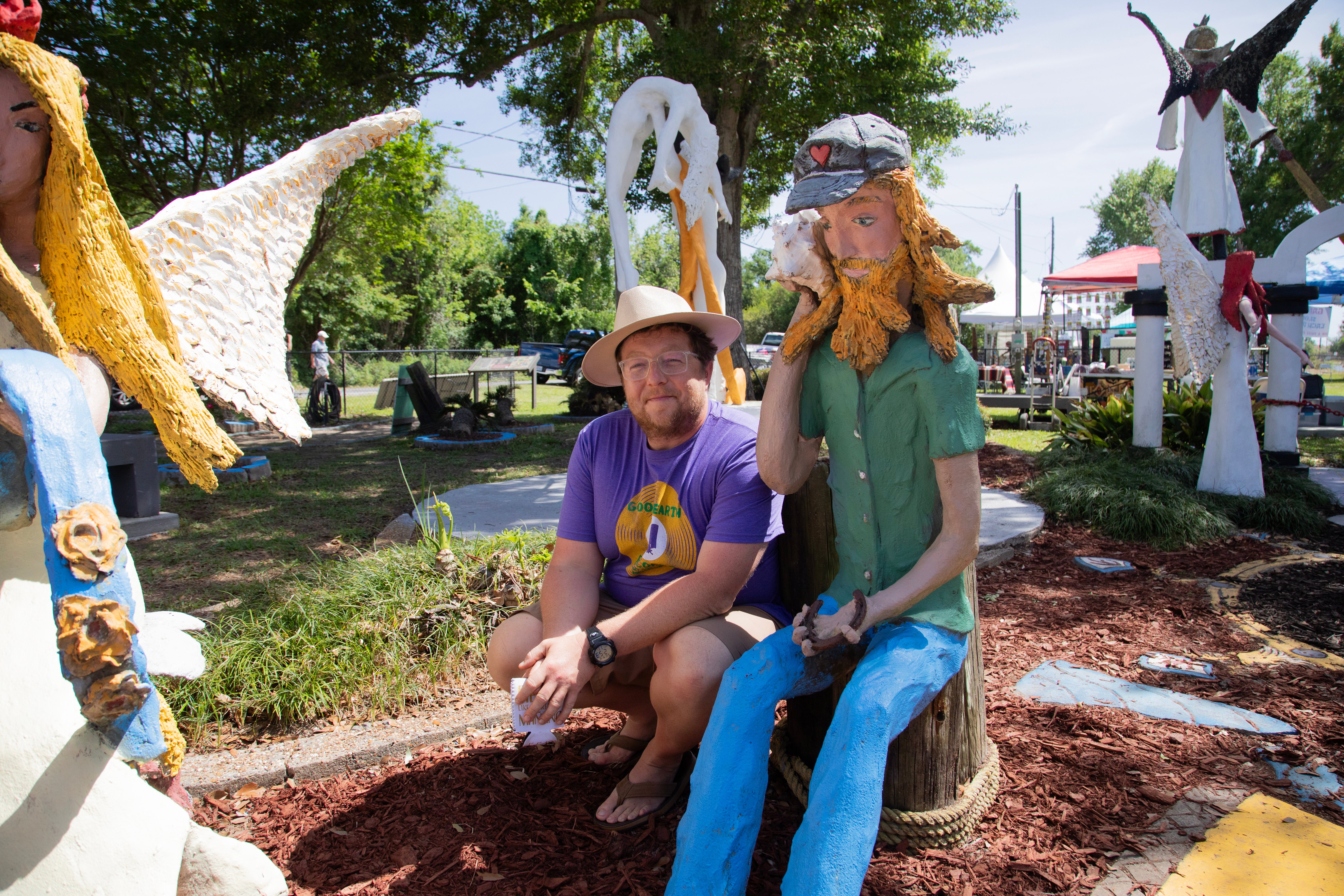
Andrew Cuneo, a friend and former neighbor of Kenny Hill, poses next to a self-portrait statue of the artist.
By all accounts, Kenny Hill was lost by the time he wound up in Chauvin, Louisiana in 1988: a father of three children on the heels of a painful divorce. It’s not exactly clear what brought him here. Chauvin isn’t even technically a town, just a “census-designated place,” and at the time it held fewer than 4,000 residents. (Today, that number is even smaller.) The region’s economy centers heavily on the oil and fishing industries—but Kenny, a stonemason by trade, was versed in neither. Perhaps there was no plan at all. He simply left his family in Baton Rouge and headed south, stopping only when the asphalt turned to brackish water.
What we do know is that upon discovering an unoccupied stretch of land along the bayou, Kenny set up camp. Eventually, he struck a deal with the nearby property owners to build a rudimentary shack on the water, where he paid a couple hundred dollars in rent per year in exchange for keeping the grass mowed. For the next decade-plus, he spent his summers in Missouri laying bricks, and his winters back on the Bayou, pouring pounds of concrete into something shaped like salvation. He never asked permission to start building; according to neighbors, one day, the scenes just started to unfold.
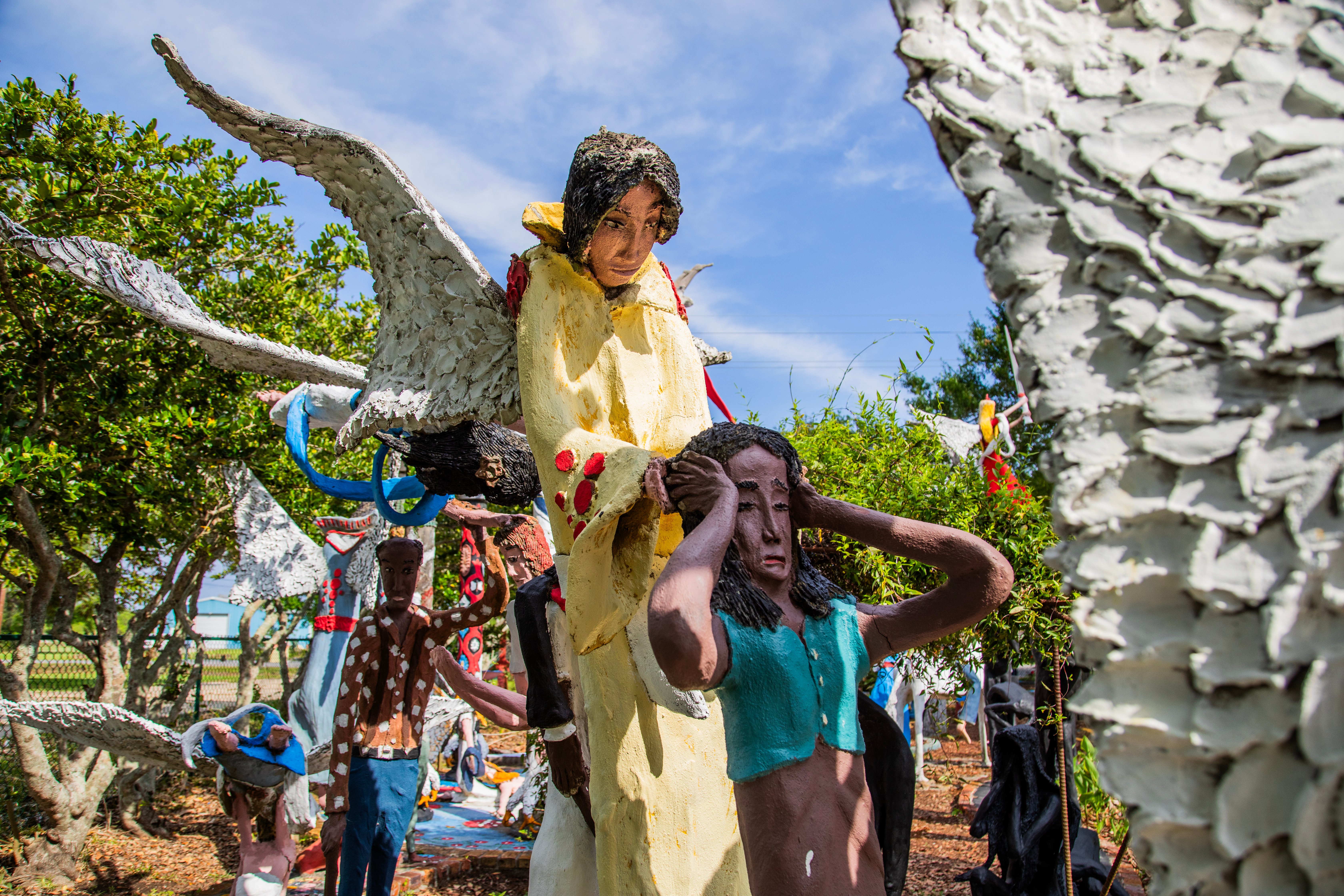
Kenny’s garden spreads across the property in a crowded, almost overwhelming sequence of acts: more than 100 statues, many of them angels, many of them versions of himself. The installation culminates in a dizzying, 45-foot-tall tower made with over 7,000 bricks. Its structure seems to tell the story of the United States: hanging off it are Native Americans and cowboys wielding pistols, World War II soldiers lifting Old Glory overhead, Black musicians blowing into saxophones. (And on the backside, inexplicably, two busty women frolic in a waterfall. It’s not immediately clear what historical event they’re supposed to represent.)
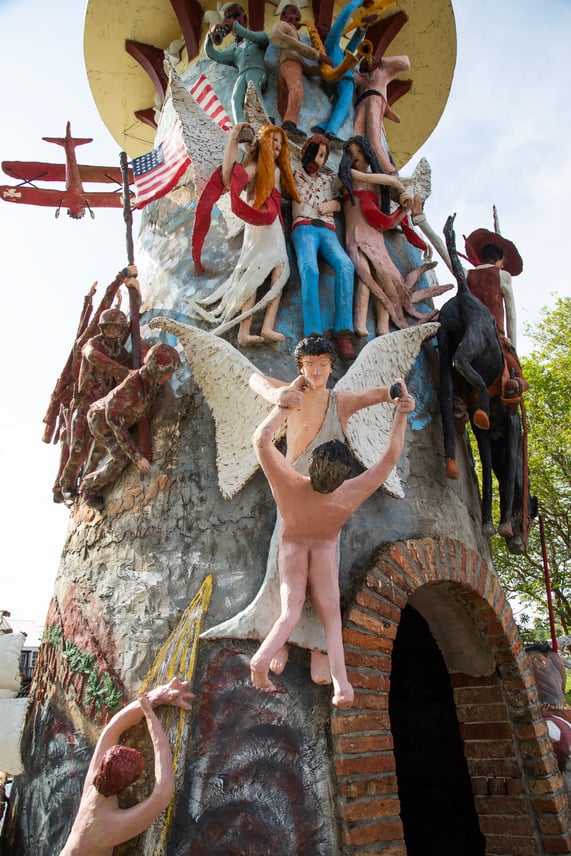
One of the first statues Kenny constructed was a seven-foot tall man, painted entirely white, holding a woman’s limp body in one arm and a perched eagle on the other. Art historian Deborah Cibelli has theorized, based on his personal history, that it represents “an estranged couple cast out of paradise, like Adam and Eve.” Behind the sculpture, a robed statue of Jesus hoists a wooden cross onto his shoulder. He reaches an arm back for yet another version of Kenny, who—in this depiction, appearing younger, his trademark blond beard cropped close to his face—struggles to lift a cross of his own.
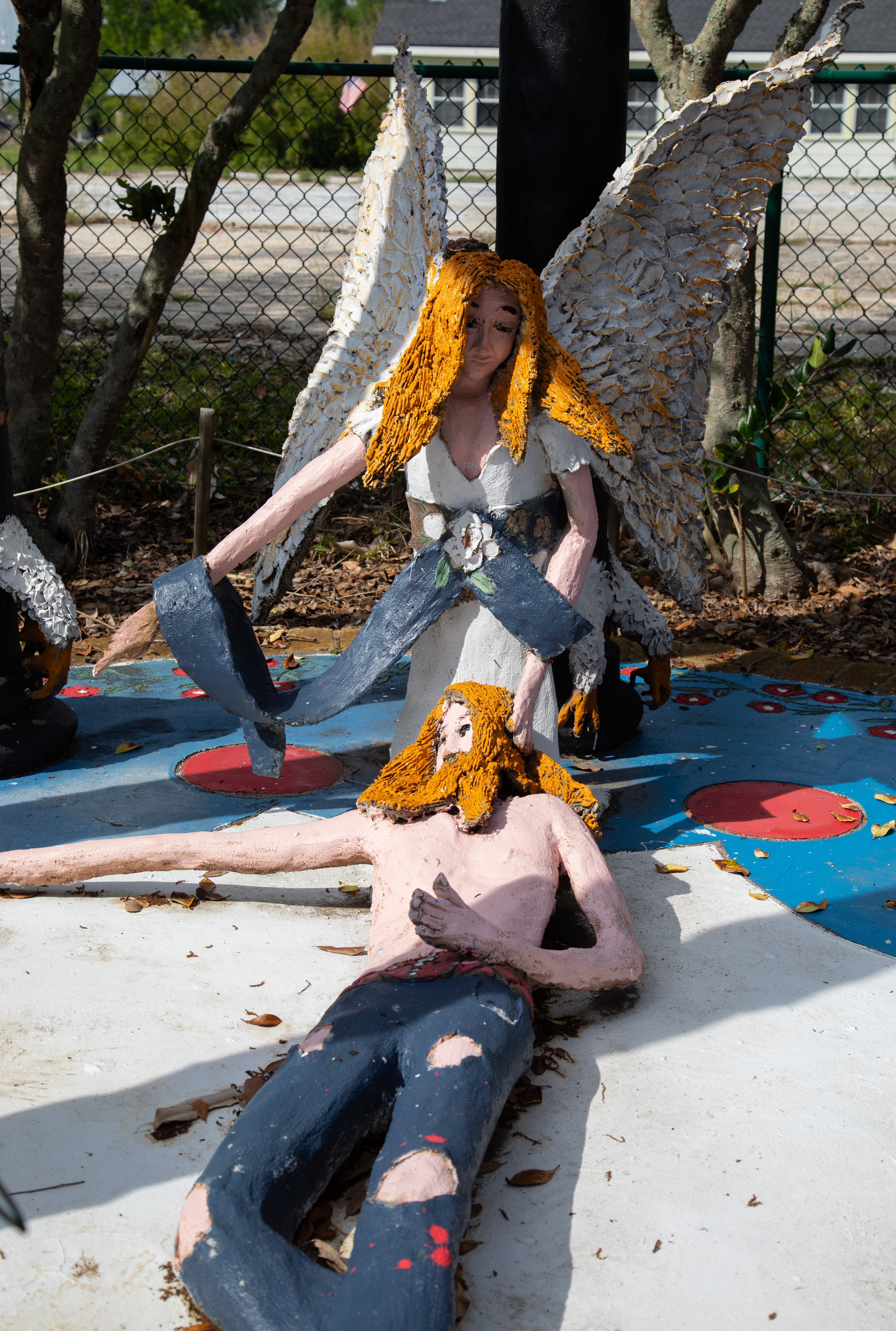
A few steps away, a gazebo appears on the right side of the garden: half-formed faces emerge from its columns, as if pressing out from inside the concrete, anchored at the base by a ring of eagle talons. In the center, a weary Kenny rests his head in the lap of a winged angel. In his final iterations, our mysterious sculptor begins to resemble the son of God himself: his hat is discarded, and he lays shirtless and weak, torn jeans dripped with blood. Or perhaps that’s just spilled paint from the red flowers nearby. There’s no way to ask.
Still, the garden is only part of the story.
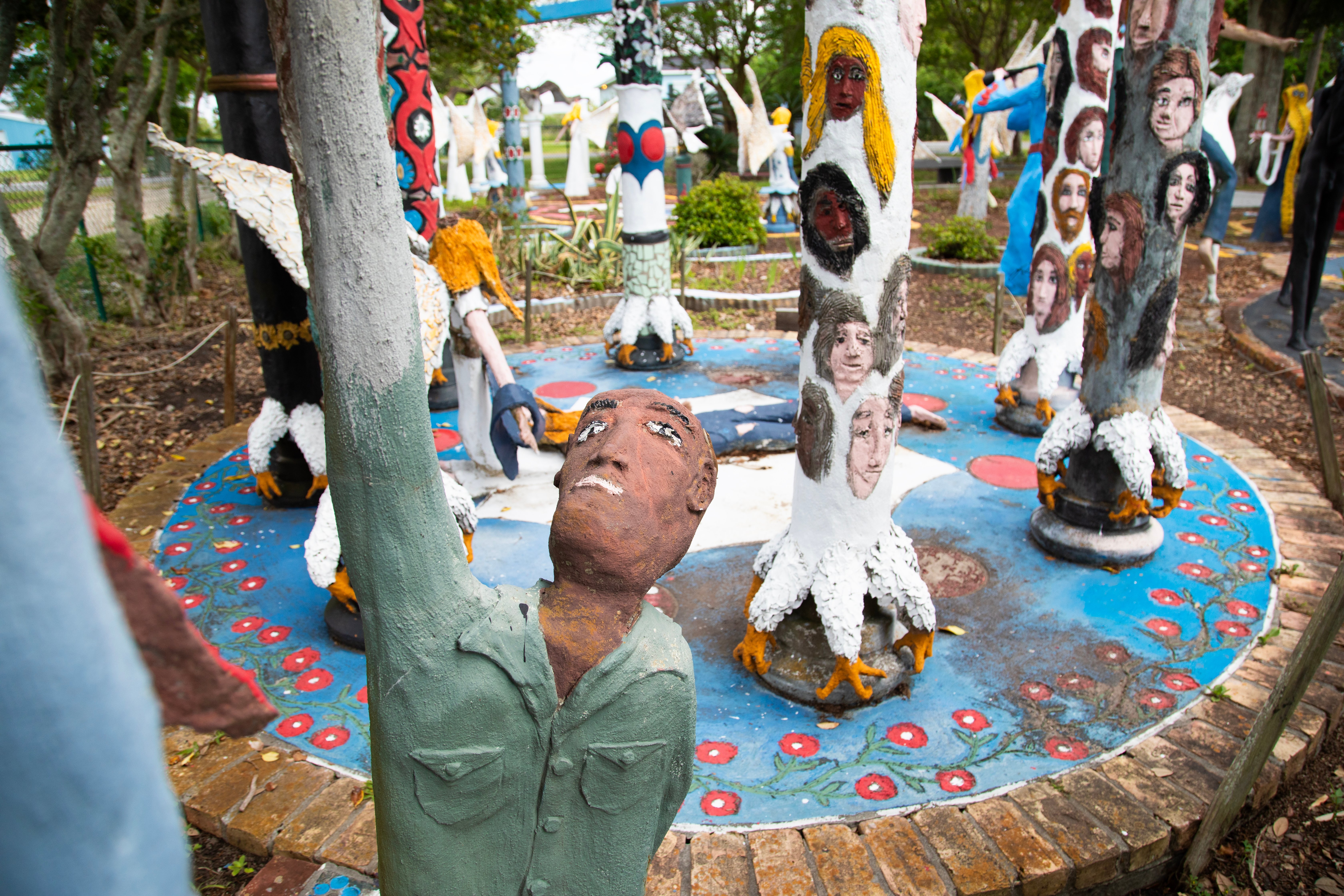
Andrew Cuneo, who grew up down the street, with his grandma next door, remembers Kenny differently than most.
His father Errol, a firefighter, was strict about where his son was allowed to go. He’d responded to many dark calls in the community, from arson to overdoses, and as a result, ran a tight ship when it came to safety. Still, the young boy knew he was always welcome to walk down the road and visit his eccentric neighbor, no questions asked.
Often, he didn’t have to go far. Many nights, Kenny could be found in the kitchen of Cuneo’s grandma, filling up on a bowl of jambalaya after helping her fix her car.
“My grandmother, her being that age during that time, and being a widow, stuff was always breaking… and Kenny was always around to help,” he says. Sometimes the elderly woman paid him; other times, a warm dinner sufficed.
Cuneo recalls one Thanksgiving when his father noticed that Kenny didn’t have a winter jacket. Out the window, his skinny frame could be seen hunched over a budding sculpture, arms protected only by a T-shirt. Errol walked over and gifted him an old firefighter coat. Come Christmas Day, apparently, Kenny felt the need to return the favor.
“He’d come across a litter of puppies, I guess, and he grabbed one of them, and that was me and my brother's first dog as a kid for Christmas,” Cuneo laughs. “We named her Lucy. I’m not sure he asked my Mom about that.”
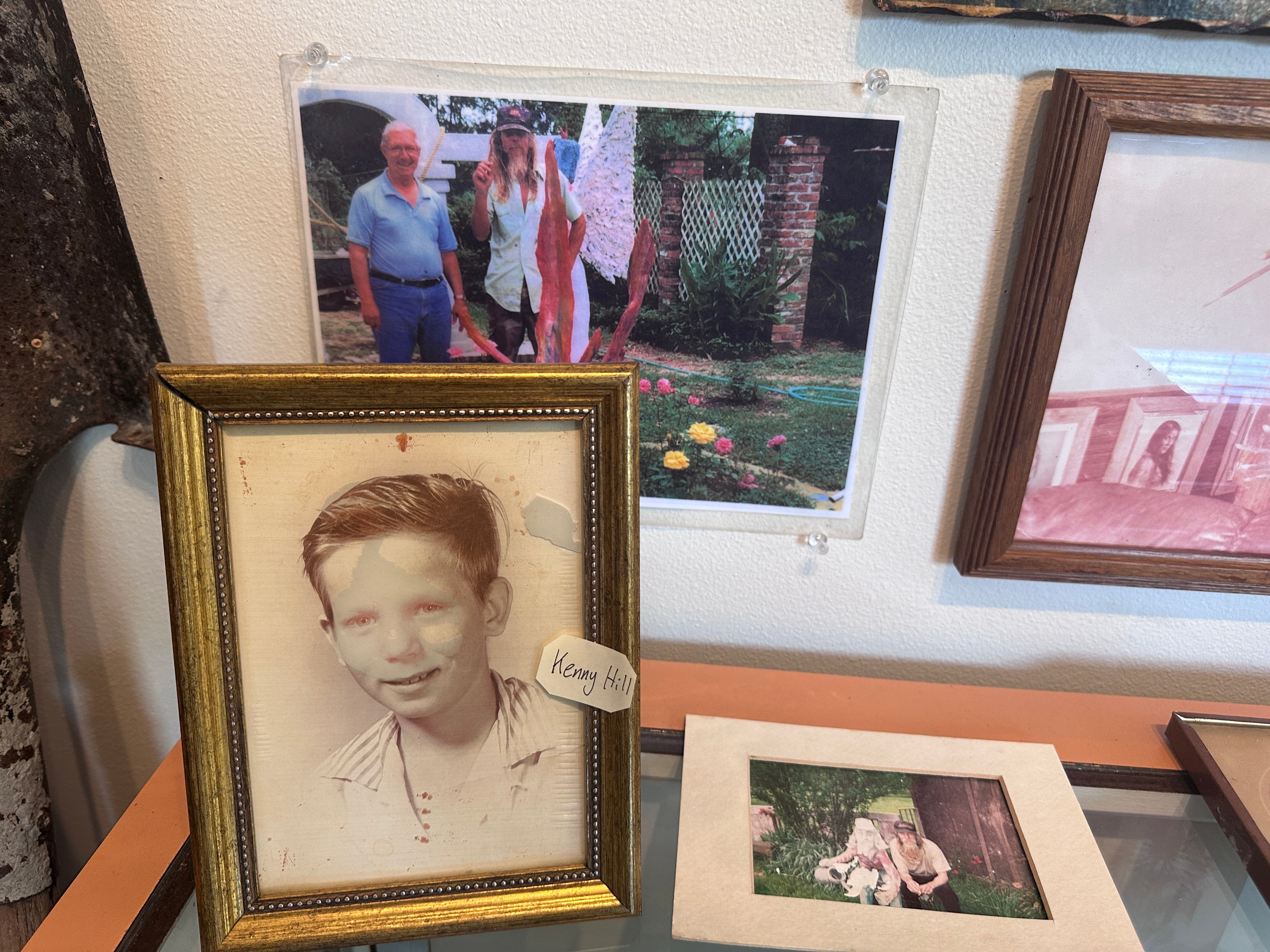 Photos of self-taught artist Kenny Hill are on display at the one-room museum across from the Chauvin Sculpture Garden.
As the years went by, the Cuneos considered Kenny a friend, and even helped him source materials for his installation—although they never quite understood the purpose. Errol knew a guy who owned a paint shop in town, and when its warehouse needed clearing to make room for more inventory, he’d hitch up the trailer and give Kenny a ride, returning back with a load of mix-and-matched paint samples. From their home down the bayou, they watched his garden grow.
Then, one day, when Errol was driving Andrew back from school, they spotted that faded yellow firefighter jacket bobbing down the road. It was Kenny, carrying only a rucksack on his shoulder.
“My Dad pulled over and asked him what was going on, and he explained that he’d been evicted,” Cuneo recalls.
He told them he was heading to Arkansas, where his brother lived. They offered to buy him a bus ticket, or even help pay the rent, but he refused, promising to send a letter when he arrived. It came in the mail two months later: Kenny had made it, over 300 miles away, on foot. That was the last they ever heard from him.

The first time Gary LaFleur visited the garden, it was the winter of 1999. A biology professor at Nicholls State University, he was driving to a marine lab at the end of Bayou Road to teach a class, when something caught his eye.
“It was a little spooky, because it was hard to tell if somebody was there or not,” he recalls. “I walked into the garden. You know, it was kind of overgrown at that time.”
LaFleur trudged through the knee-high grass, unable to shake the feeling of being watched, although that could have been the hundred-odd eyes of concrete celestial beings peering down at him. Then, from inside the shack’s darkened window, a face appeared. “I saw Kenny pull back the curtain,” LaFleur says. “He just kind of nodded, like, go ahead. I got the feeling he was okay with me walking around his garden. It was just sort of like a gentle permission.”
That brief interaction was the only moment LaFleur ever set eyes on him. The next time he returned, it was to bring along Dennis Sipiorski—a friend, and the head of the art department at Nicholls—to see the site before it was too late.
After Kenny left, his landlords were planning to demolish the place. Depending who you asked, the garden had become an eyesore at best, and at worst, a lawsuit waiting to happen: barbs of rebar metal stuck out from half-finished sculptures, and the unattended brick tower had begun to attract trespassing teens. Meanwhile, Parish officials quoted the owners $300 a month to mow the lawn, just to avoid fines.
The story of why Kenny was evicted has a few different versions. LaFleur says he’s spoken to members of the landlords’ family, who said, You know, we didn’t really want to kick Kenny off the property, but he just wouldn’t talk to us. He wouldn’t communicate with us, so we didn’t know what to do. Kenny’s mother had died earlier that year, which reportedly devastated him, leading the artist to withdraw.
According to Cuneo, Kenny actually spent most of ’99 up north in Branson, Missouri, laying bricks to save money for more sculpting materials. In that time, Cuneo says, the yard became unmanageable. The elderly couple who owned the property called the Parish to come cut the grass, and by the time Kenny returned, he was not only facing rent, but a few thousand dollars in Parish fees. His eviction notice lists the “reasons for wanting you to quit the premises” as “The rent was due JANUARY 1, 2000 and not paid”; it is dated January 3rd, only three days later.
One person I spoke to at the festival—who doesn’t live in Chauvin, but has spent considerable time there—says the yard wasn’t the problem. “Kenny was gone every summer in Missouri, you know damn well the grass wasn’t getting mowed then. It wasn’t that,” he said. “The general feeling is that [the owners] wanted this property for the boat tie-ups. And so they started pecking away at him, about various things. That really, I mean, it broke his spirit.”
According to them, because Chauvin is such a small community (“everyone here is related to everyone”), the story of Kenny’s eviction has been rewritten. It’s difficult to be sure: the landlords have since passed away, and Kenny has never shared his version of events. What is undisputed are the relentless efforts of the people who came afterward, determined to save the garden.
When Dennis Sipiorski arrived at the site a few months later, he immediately recognized what he’d stumbled upon. He reached out to artist Greg Elliot, a former coworker, to tell him there was a treasure trove down in the Bayou he ought to lay eyes on, and quick. Elliott made the drive from Baton Rouge, armed only with a U.S. Geological Survey map splayed out on the dashboard. His friend, printmaker Kimberly Arp, sat in the passenger seat, helping to navigate a smattering of barely developed roads through the coastal marsh. When they arrived at the coordinates, the grass was easily eight or nine feet high.
“We all three split up, walked in to look around,” Elliot recalls. “And about ten minutes later, we came back out to the road and looked at each other, and at the exact same time, went: this cannot be destroyed.” The men shook on it then and there. If the Parish’s only hurdle was overgrown plants and some rickety construction, then dammit, they’d fix it themselves.
“We said, we’ll take care of that. So we cleaned it up, mowed it, for what—about four months, five? Just taking endless truckloads of shit to the dumps.”
Not long after, Sipiorski contacted the Kohler Foundation, a philanthropic organization dedicated to preserving art. When one of its administrators visited the site, she said she felt as if she’d been “transported to another planet.” The Foundation purchased the property from the landlords and donated it to Nicholls State University, which has maintained it as a free and open public space ever since.
People often ask LaFleur why the university doesn’t charge an entry fee. Each time, he is reminded of that winter in ’99, the shadowed face in the window and its nod of “gentle permission.” “It wouldn’t be in the spirit of what Kenny built,” he says.
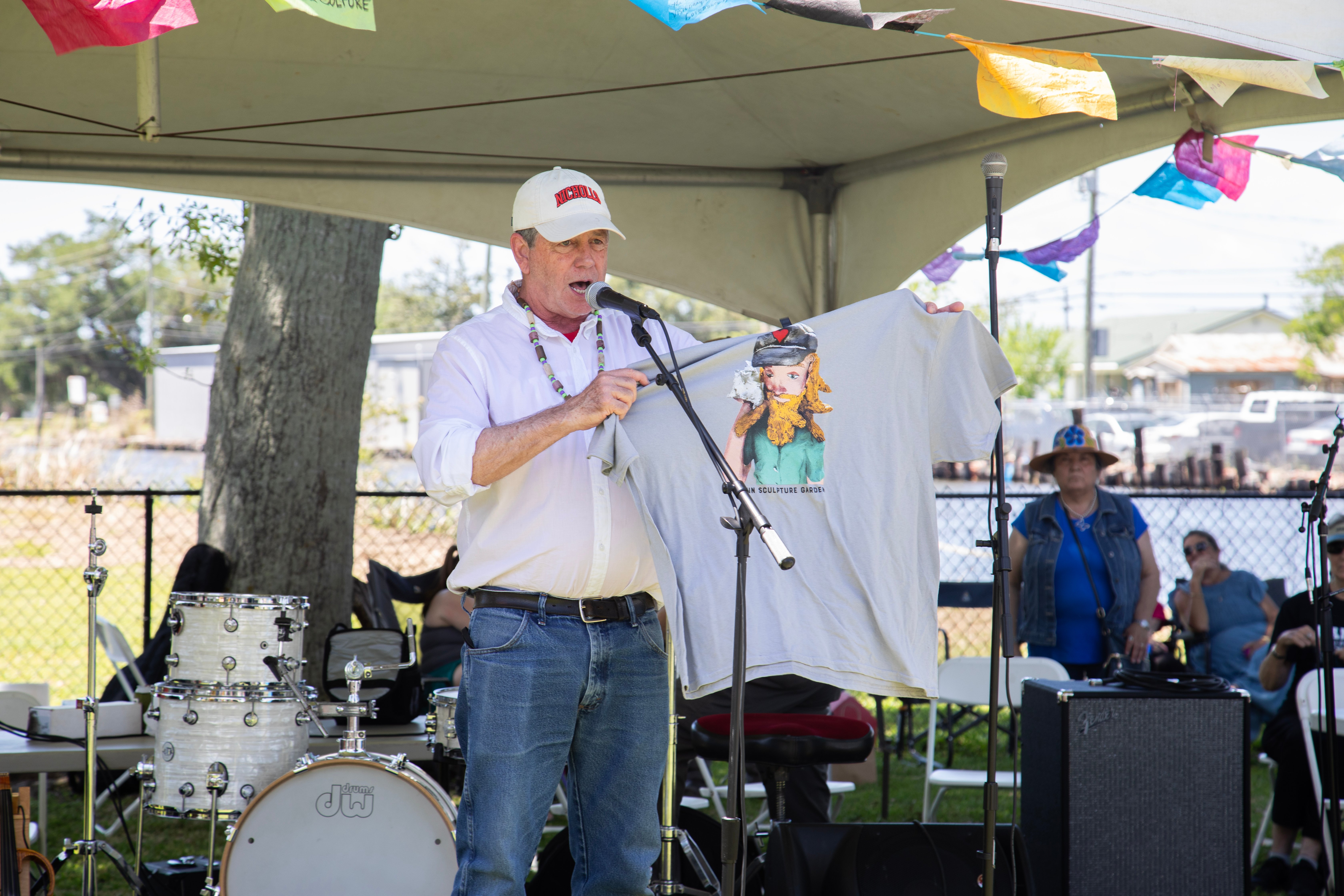 At the 2026 Chauvin Folk Art Festival, Gary LaFleur raffles off a t-shirt printed with a sculpture of Kenny Hill. Proceeds from the event went towards the maintenance of the sculpture garden.
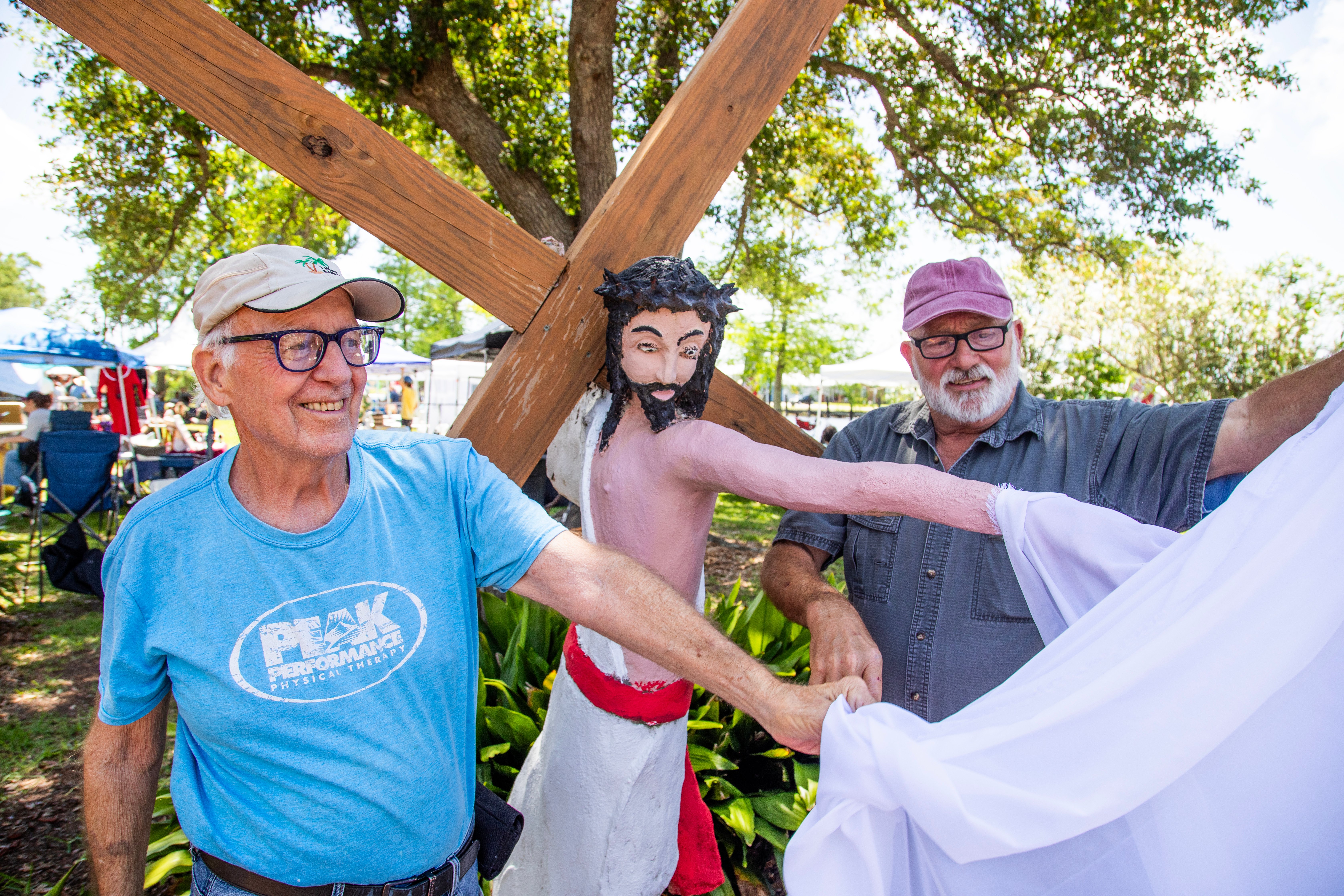 At the April 2026 Chauvin Folk Art Festival, artists Kimberly Arp and Greg Elliott unveil one of several statues they restored after Hurricane Ida.
For Elliott, the garden is more than a local curiosity. He’s spent the last 40-plus years as a professionally trained sculptor—holding three degrees in various concentrations and teaching roles at multiple universities—yet throughout his research, it has always been “outsider art” that intrigues him most.
“If you talk to people in academic fields about ‘outside art,’ there are people who, like us, think it’s incredible,” he says. “Then there are so many who turn their nose up and say, ‘They didn’t go to the academy. They don’t have training. This work has no purpose.’”
“To those people, I say: then why do we study cave paintings?”
His retort gets to the heart of the question all art historians seek to answer. What does art mean—to the ones who create it, and those who view it? People seeking the answer often start with the very first examples in human history: smudges from the fingertips of our early ancestors, whose sole purpose seems to be saying I was here.
The earliest known human artwork was discovered in a cave in Indonesia, dating back 45,000 years, and shows two pairs of hands dipped in red pigment and pressed against a limestone wall. For historians and philosophers alike, it was this act that differentiated humans from all other forms of animal: the ability to create something outside of themselves, solely for the purpose of expression. Art, then, is not something earned through credentials and academic study. Nor is it something that must be bought and sold like any other commodity, a product to be justified with profit. It is innate. It’s what makes us who we are.
This philosophy is what draws Elliot, and others like him, to the greatest folk artists of our time: Howard Finster, the Baptist minister from Georgia who claimed God called him to spread the gospel by transforming his swampy land into “Paradise Garden,” a sculpture garden with nearly 47,000 pieces of art; Simon Rodia, the Italian immigrant who spent three decades building a series of 100-foot towers from scrap metal in Los Angeles; Helen Martins, who covered her childhood home with crushed glass and mirror after her father’s death, hoping to “add color and light” to her life. And of course, Kenny Hill.

Over the years, the garden has been threatened again and again—not only by natural disasters, but manmade ones.
After Hurricane Ida caused severe damage to the sculptures in 2021, Elliott was flown in from out of state to assess the damage: trees were strewn across the property, limbs torn from angels, entire statues knocked over on their side. Kimberly Arp joined too, reuniting the same team who’d rescued the garden so many years before. Then, one night, as they were still assembling a restoration plan, a vandal entered the property. The two bathing beauties by the waterfall had their legs broken; a cowboy’s arm was severed at the elbow. Most devastating of all, a statue of a young girl, peering at her reflection in a painted river, was missing entirely.
“That was a hard day,” LaFleur remembers. “We were already reeling from Ida. And now, this was something we couldn’t replace.”
Then, one of the garden’s volunteers noticed something: embedded drag marks in the grass led right from the statue’s former resting spot all the way to the bayou’s edge. The missing girl might only be a few feet away. Gary LaFleur knew friends at the nearby biology lab who had sonar equipment, and could assist with a scuba dive—but given the destruction of the recent hurricane, it would all take too long to coordinate. Instead, he took his shirt off and jumped into the water.
“I wasn’t too worried about gators, but I was really hoping not to find broken glass,” he says.
Holding his breath, LaFleur swept his arms through the thick mud floor, pushing through downed branches and debris. The muffled sounds of volunteers cheering him on could be heard from above water. Finally, he struck something solid. When LaFleur surfaced, gasping, he had the statue hooked under his arm. He dragged it back to shore himself.
After the storm, it would take several years to restore the garden to its former glory. Realizing how many hours this project required, Elliott and Arp moved into the property next door—the home belonging to Andrew Cuneo’s grandmother, who had since passed away. They relied on old photographs of Kenny’s work to match his exact paint colors, and experimented with various techniques to get the statues to balance just right, their roots planted in an earth that was rapidly waterlogging.
At times, preserving this space felt like trying to build a sandcastle when the tide is rising. And it is.
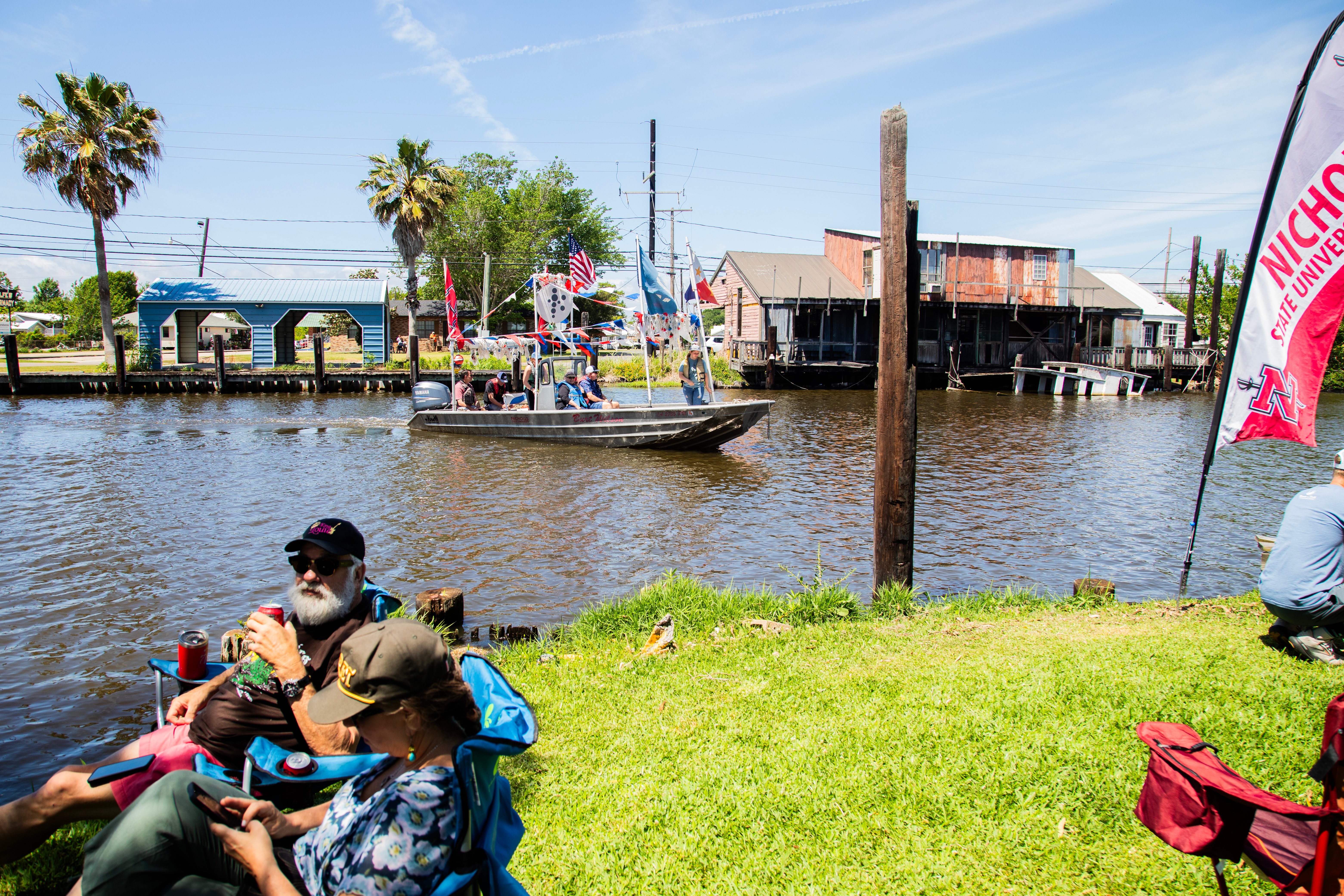 Boats pass through the Bayou Petit Caillou during the annual Blessing of the Fleet in Chauvin, Louisiana, on April 17, 2026.
Louisiana’s coastline is vanishing at a rate of 14 football fields of land per day, taking with it homes, jobs, and entire communities. Since Kenny’s disappearance in 2000, Chauvin’s population has dwindled from 3,200 to an estimated 2,400. As hurricane seasons become increasingly brutal, many families can’t afford to rebuild from the damage, and job opportunities have stalled. Yet as difficult a place as it may be to live, it can be equally hard to leave. Many residents here are part of the third, fourth, or fifth generation to live on their land, and they’ll sooner learn to swim than walk away.
On a sweltering Sunday afternoon in April, dozens of local residents and out-of-towners have gathered at the Chauvin Sculpture Garden for the annual Folk Art Festival, staged the same afternoon as the “Blessing of the Fleet.” The Blessing is a yearly tradition held at the beginning of shrimp season, where a local priest blesses each fishing boat with holy water to prepare them for a fruitful harvest ahead.
Professor Gary LaFleur takes the stage, a plastic cup of champagne in his hand. First, a toast to Kenny. Then, he reminds the audience that when the boats pass, we shouldn’t raise our beer cans: “The priest isn’t a fan of that,” he says, only half joking.
This is Catholic country, after all, but above anything, it’s Cajun. The Blessing of the Fleet may be symbolic, a reason to celebrate the season ahead, but many residents here are truly counting on something divine to save their way of life. If the fishing industry dries up in Chauvin, so does an entire culture.
After the 2010 Deepwater Horizon oil spill, Louisiana’s shrimp landings slashed by more than half, reaching the lowest number in 50 years in 2024. Even when fishermen do reel in big, it’s not paying: shrimp prices fell 40 percent in 2024 alone, mostly due to an influx of cheap foreign imports. Oysters are faring no better, with a 2019 study by the Department of Wildlife and Fisheries finding the lowest population ever recorded in Louisiana’s public harvest areas.
The people of Chauvin could use a miracle, and at the very least, being surrounded by Kenny’s angels can’t hurt. That’s why LaFleur, a marine biologist, brings his students here.
“I invite students to come to the art festival, and then I like them to see the shrimpers go by with the families on the shrimp boat, the generations of people there,” LaFleur says.
In his classes and beyond, he’s come to use the garden as a vessel to speak about something larger. It’s one thing to be lectured about the life cycle of a fish, he says, and be told that its population is shrinking; it’s another to come to a magnificent art site, to witness the faces of the neighbors who care about it, and realize their population is shrinking, too.
“Then, usually they’ll see a house that’s abandoned with no roof, y’know? And then, almost if you look hard enough, you can see it on the faces of the community members. You can see the struggle—the people that are still there, they’re just, they’re just hanging on,” he says.
“It’s not just coastal land loss, but it’s really loss of communities. And then, you know, the final layer is, if you lose the community, you’ve lost something else that’s hard to measure, and that’s culture.”
In the decades since his departure, Kenny Hill has given his neighbors a reason to come together. Seeing dozens of strangers gathered in his garden is bittersweet; it’s a community he never quite ingratiated himself in, whether by choice or not.
Andrew Cuneo is the only person at this year’s festival who’d ever exchanged more than a handful of words with Kenny. His father, the firefighter, died in 2019, and his grandmother before that. Today, Cuneo is serving bowls filled with her jambalaya recipe: free of charge, unless you’d like to donate a few bucks to help maintain the garden.
Kenny’s family appears to have visited the sculptures in their own time. Once, in 2007, a postcard appeared in the donation box:
To whom it may concern,
I Maxine Hill Sparks ex wife of Kenneth Allen Hill Sr. came by to see the garden which is beautiful. Kenneth has 3 children, Kenny Jr., Retha, Mary. Their Daddy is not a hermit. he was only a lonely man. We were married Nov-30-1969 in Baton Rouge, La. Thank you’ll for keeping his work alive. Also he is alive and well.
Kenny is still alive now, in his mid-70s, as far as Gary LaFleur, Greg Elliott, and the other keepers of the garden know. They’ve heard that he is back in Baton Rouge, possibly living in an assisted facility. Online obituaries show that his ex-wife, Maxine, died in 2017, and his son, Kenny Jr., the following year.
He has turned down all requests to visit the garden.
“I kind of struggle with it,” LaFleur says, referring to the knowledge that Kenny is still out there. Sometimes the professor attends meetings about the preservation of other folk sites, where people insist that he’s got to track Kenny down, and get an interview before it’s too late.
“But I am not convinced,” LaFleur says. “I don’t think that’s what Kenny wants. I mean, it’s wrong for me to act like I know what Kenny wants, exactly—but I got the feeling that Kenny did not express himself verbally. Or didn’t know how to. He probably didn’t know how to explain his feelings, but he knew how to draw it, and put it in a garden.”
Across the street from Kenny’s sculptures, a one-room museum holds photographs and items recovered from his home, shortly before its demolition. If you’re hoping it holds a diary, manifesto, or map, you’ll be disappointed. Still, there is one surprise: three sheets of hand-written song lyrics and a signed contract with Sunrise Records, dated 1983. There’s also a royalty check made out for 50 cents, payment for eight vinyls sold. Kenny wasn’t much for talking, but at some point, he must have sang.
I just want to love you
And kiss your tears away
I’m always thinking of you
So remember
Love will never go away
– “Love and Kisses,” Kenneth Hill

.jpg?width=352&name=Bald_Eagle(2).jpg)
.jpg?width=352&name=Untitled%20design%20(2).jpg)
.jpg?width=352&name=Untitled%20design%20(1).jpg)