In “Believe: Why Everyone Should Be Religious,” the New York Times columnist tries to reverse the trend of a more secular society. But his reasoning just doesn’t add up.
According to Pew’s most recent Religious Landscape Study, a growing share of Americans identify as atheists, agnostics, or “nothing in particular.” These so-called “nones” made up 16 percent of the population in 2007, but 29 percent in the latest survey, from 2023-24. The trend among younger Americans is even more striking. In this latest survey, 43 percent of those born in the ’90s and early aughts identified as nones.
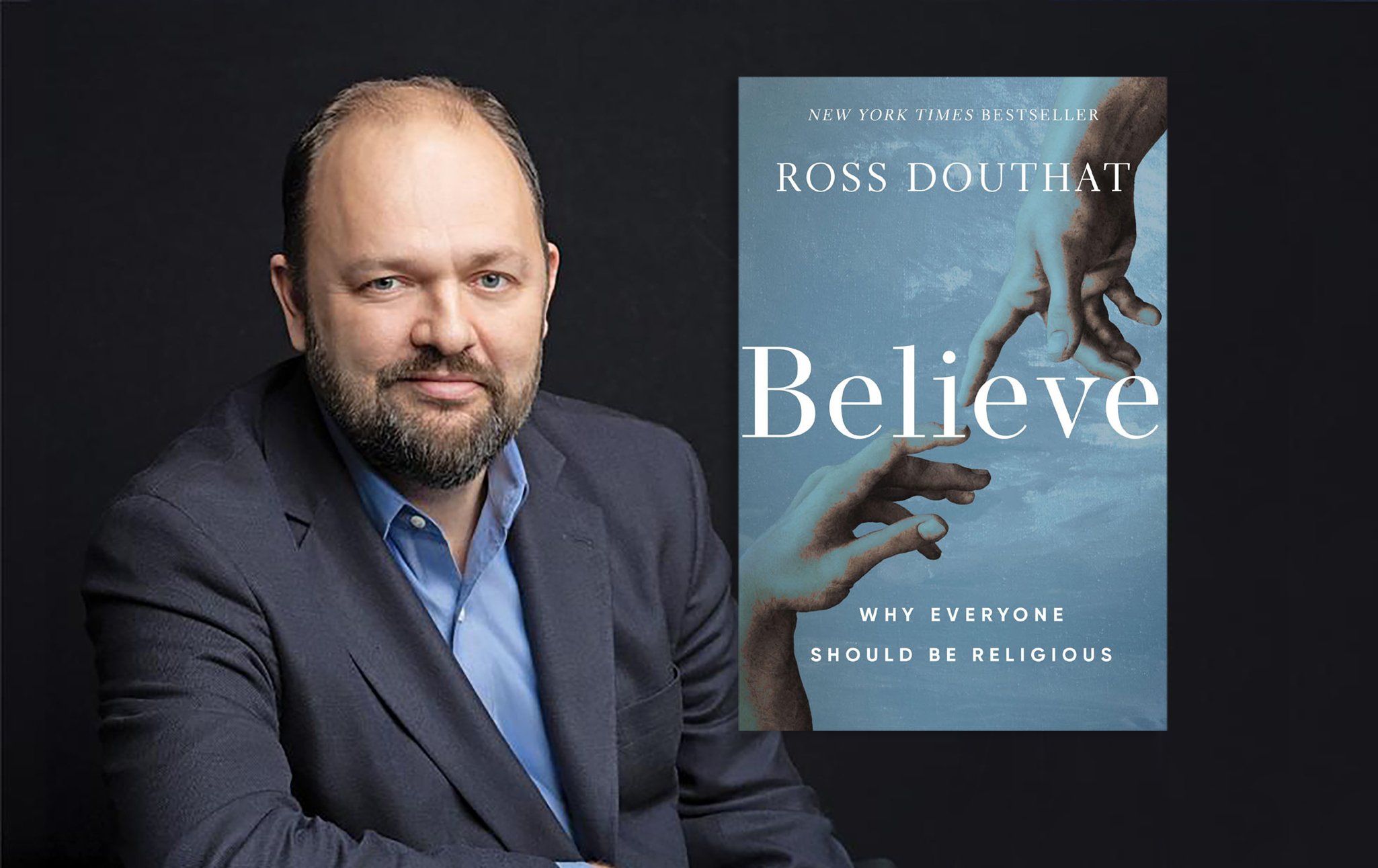
In Believe: Why Everyone Should Be Religious, Ross Douthat, a columnist for the New York Times, hopes to stem the tide. Referring to the Gospel of Mark’s admonition to be awake when the “master of the house” (i.e., God) returns, Douthat warns the reader: “If you are this sleeper, I beg of you—awake.” But he doesn’t think there are only fear-based, prudential reasons for believing in God. He thinks there’s good evidence that God exists. “The religious perspective,” he explains, “has the better case by far for being true.”
At the start of Believe, Douthat says part of his job at the Times is “to make religious belief intelligible to irreligious readers.” Believe is an outgrowth of that project, and succeeds at the task; it is clear what Douthat takes his factual premises to be and how he thinks one can infer from those premises to a theistic conclusion. The problem is that many of those premises are false or suspect, and many of the inferences unwarranted. His conclusion, that we should all be religious, is a house built on sand.
Douthat asks the reader to imagine being back in a time when “the burden of proof was on the skeptic, when atheism was a curiosity and supernatural belief the obvious default.” No longer blinkered by a secular worldview, you’d no doubt notice “regular-seeming, complex, and predictable systems,” like the change in seasons and the workings of the body. You’d also notice that the biological world is filled with “complex machines” nested within complex communities. These biological systems appear not to be the result of “simple accident.” Surveying all this, you’d conclude that “some Mind or Power must have made or organized all this matter for a reason, or else the Mind or Power is somehow inherent to the system, and the cosmos is itself divine.” Douthat insists that this is the correct conclusion to draw; it’s what best fits the evidence. This is the argument one would find in natural philosophy until the later 19th century. For instance, it is the perspective that William Whewell articulates in his influential contribution to the Bridgewater Treatises.
If that’s the “religious perspective” of our origins, what’s the contemporary “scientific perspective?” As summed up by NASA, it holds that the universe came into existence about 14 billion years ago and is filled with (conservatively) hundreds of billions of galaxies, each of which has hundreds of billions of solar systems. Our solar system is but one among these. Earth is billions of years old, as is life on Earth. All plants and animals trace back to a common ancestor, and the organization one sees in the biological world can largely be attributed to natural selection. Our species appeared relatively recently, a few hundred thousand years ago, apparently the last to emerge among the many species of upright hominids that lived within the past 7 million years.
Note that, while this scientific perspective doesn’t posit a God, it doesn’t strictly rule one out either. Of course, the perspective does raise some challenging questions for someone (like Douthat) who believes in the Judeo-Christian God. (In Believe, Douthat describes himself as “a conservative Catholic by the world’s standards.”) If we humans are special, why did God wait billions of years to create us? Why did He make many trillions of other solar systems? And, perhaps most pressing, why is none of this mentioned in the Bible? One possibility is that God wanted to speak metaphorically in Genesis about our origins. Another is that those stories were created by people who were trying their best to explain how the world around them came to be. If they had known how old and big the universe is, or that humans share a common ancestor with fish and olive trees, they would have incorporated those facts into their origin story. But they didn’t, so they didn’t.
Douthat isn’t a Biblical literalist, so far as I can tell; he doesn’t disagree with the factual claims of this scientific perspective. Unlike some American evangelicals, he does not claim the Earth is a mere 6,000 years old, or that the story of Noah’s ark literally took place. But he rejects that the scientific perspective licenses a rejection of belief in God. Recall that he doesn’t just say the religious perspective is consistent with our experience, but that the perspective has the “better case” for being true.
Why? Most of Douthat’s arguments for this conclusion involve the claim that the universe was “made for us,” though he uses that phrase in a few different ways.
One way the universe is “made for us,” according to Douthat, is that science’s ability to explain natural phenomena—planetary orbits, say—is evidence that humans were designed in part to understand the universe. Douthat doesn’t think the scientific perspective explains how this could be so. “Why should capacities that evolved because we needed to hunt gazelles and avoid predators,” he asks, “also turn out, mirabile dictu, to be capacities that enable us to understand the laws of physics and of chemistry, to achieve manned spaceflight, to split the atom, to condense all of human knowledge onto a tiny piece of silicon?” Douthat says this would be analogous to developing a secret language with your friends and then finding out, many years later, that the language allowed you to read “a set of ancient texts, as complex as Shakespeare and Aristotle put together, that contained all the secrets of Mayan astronomy, Greek philosophy, and Egyptian mysticism, and that you happened to discover hidden in the attic of your childhood home.” Wouldn’t you assume, Douthat asks, “that you were a character in a larger story, and that the book was in some sense placed there for you?” Douthat thinks we humans are “the readers that the book of nature was awaiting all along.”
That argument sits uneasily with Douthat’s claim, elsewhere in the book, that we don’t understand some important bits of our existence, like consciousness. He says that “the immense progress we’ve made in figuring out how chemistry and biology interact in the pathways of the cerebellum has brought us no closer to answering the question of why these physical interactions yield both conscious self-awareness generally and the specific kind of experience we have.” Douthat takes science’s inability to explain consciousness to be evidence that the mind has a “supernatural character.” When we put these two arguments side by side, we see that together they make a rigged game: if science can render some natural phenomenon intelligible, then that’s evidence for God; and if science can’t render some natural phenomenon intelligible, then God must be the supernatural force pulling the strings. Heads theism wins, tails atheism loses.
Another way that Douthat thinks the universe is “made for us” is that many of its physical properties—e.g., its rate of expansion, the strength of nuclear forces—fall within a narrow range of values that would support life. The idea here is that the existence of a designer would make these life-supporting properties far more probable. This is the so-called “fine-tuning” argument for God’s existence.
One reaction to the fine-tuning argument, which I favor, is that the argument fails to take into consideration what’s called an “observation selection effect.” Applied to this case, once you condition on the fact that life did emerge in this universe, then it follows, simply as a matter of logic, that the universe’s properties support life. Hence, positing a designer does not make those life-supporting properties any more probable. That doesn’t mean that a designer doesn’t exist, but it does mean that positing a designer doesn’t provide any additional explanation as to why we observe a universe that is so finely tuned.
Finally, Douthat thinks the universe is “made for us” in the narrower sense that the sort of consciousness that humans possess—“the kind that’s capable of building civilizations that can send signals and messages and ships out into the forbidding deeps of space”—is rare if not unique. Douthat’s evidence for this bold claim is that we have not been visited by, or received messages from, alien civilizations. There are of course a number of other explanations for why, despite the universe’s vast size, Earth has not been contacted by alien civilizations. But let’s stipulate that Douthat is correct in claiming that our species is rare if not unique and that “our minds are part of the reason, or deeply connected to the reasons, why all of this exists.” It seems fair to ask why there would be many trillions of other solar systems if consciousness in ours (and perhaps a few others) was the end goal. Douthat doesn’t try to answer that question.
Consciousness itself, though, plays a surprisingly important role in Douthat’s book. He claims that the mind “is not reducible to matter in any way that we can ever expect to understand” and for that reason serves as evidence for “supernatural reality.” Remarkably, Douthat thinks consciousness is important in part because modern physics shows that at “the quantum level of reality, the human mind seems to play some decisive role in making physical reality take actual shape.” Douthat says this is the “Copenhagen Theory,” which posits that “the conscious observer places [sic] a mysterious but essential role in collapsing quantum possibility into physical reality.” This is,” Douthat explains, “scientific evidence that mind somehow precedes matter, that our minds have some integral relationship to physical reality, and that what holds all of the physical universe in actual existence, not just mere possibility and probability, is some larger form of consciousness itself.” Note that this argument wasn’t available to 19th-century natural philosophers like Whewell, who were writing prior to the development of quantum mechanics.
But Douthat is just straightforwardly wrong here. What he’s talking about is called the Copenhagen interpretation, and it doesn’t say that consciousness plays a role in explaining quantum phenomena—nor, incidentally, do any of the other mainstream interpretations of quantum mechanics. A standard view is that an “observation” can affect physical reality, in the sense that a macroscopic measuring device (e.g., a photographic plate) can force a microscopic object (e.g., an electron) to be in one among the many places it could have been. While this phenomenon is very strange, it has nothing to do with conscious observation. Niels Bohr, who was the figurehead of the Copenhagen interpretation, was explicitly clear on this point. To be sure, some prominent physicists, like John von Neumann and Eugene Wigner, arguably thought consciousness played a role in quantum phenomena, but this was very much a minority position, and still is.

Douthat’s scholarship here and elsewhere is weirdly poor. The only citation he has in this section on quantum mechanics is an article written by Spencer Klavan, a non-physicist who’s an editor at the Claremont Review of Books, the Claremont Institute’s in-house magazine. The discussion comes a few pages after Douthat describes the “Copernican revolution” as involving “peering through the telescopes that revealed the true scope of the universe.” But Copernicus (1473-1543) didn’t have any telescopes, as they weren’t invented until the 17th century. Douthat goes on to say that Copernicus and his followers inherited and worked within a “religious perspective” according to which the world’s “ordering should be consistent at different levels up and down.” Not so. The prevailing view in Copernicus’s time was the Aristotelian view that the physics of Earth (the sublunar sphere) was different than that of the moon and everything beyond (the superlunar sphere). Copernicus’s work was a step away from that tradition.
Following his discussion of the universe’s design and the supernatural character of consciousness, Douthat argues that miracles occur and are evidence for the divine. Douthat doesn’t give a precise definition of a miracle. A common view, one that was David Hume’s, is that miracles are violations of physical law (e.g., parting a sea). The Catechism of the Catholic Church likewise says a miracle is a “sign” or “wonder” that “can only be attributed to divine power.” We’ll have to whistle past some interesting issues about whether the concept of a miracle is even coherent. (For instance, and very briefly, many hold that parts of the physical world are governed by laws that are probabilistic rather than absolute, and it is not obvious how some single event could violate a probabilistic law.) Nevertheless, if we adopt Hume’s and the Church’s definition of a miracle, then we should distinguish miracles from events that have a low probability but are consistent with physical law. Douthat routinely conflates the two. For instance, he recounts a story of a woman whose long-broken radio, which had belonged to her deceased grandfather, came back to life on her wedding night. While improbable, it’s not a violation of physical law for a broken radio to come to life at a germane moment.
Much of Douthat’s discussion of miracles concerns healing through prayer. He describes, for instance, an adolescent’s recovery from gastroparesis after being touched by a Pentecostal faith healer. A problem we face in assessing these cases is that they are often described in obscure journals (as this one is), making it difficult to assess their credibility and whether non-miraculous explanations were seriously considered. (Gastroparesis, after all, can resolve itself, just as a broken radio can.) Presumably it is worries like these that motivate Douthat to insist that the Catholic Church’s process of canonization involves rigorous “scientific investigation” to confirm that a miracle has occurred. Those are not the words that I would use to characterize the process. In assessing whether a medical miracle has occurred, the Church itself selects the medical experts, who are sworn to secrecy. This is at odds with the widely-accepted norm in science that one’s evidence and reasoning for a conclusion should be public, and replicable by others. Incidentally, there have been more rigorous attempts to study whether prayer promotes healing. The most well-known of these found no such evidence. Douthat dismisses such studies because the “external agents” to whom we pray “can’t be subjected to normal scientific forms of scrutiny.”
My hunch is that Douthat’s arguments for God’s existence will leave many unmoved. But it’s important to remember that, even if you think something is very probably false, it can still be rational to act as though it were true. Blaise Pascal made this point in the 17th century when he argued that it’s rational to believe in God. If you believe in God and He does indeed exist, then you have an enormous gain, whereas if you believe and He doesn’t, nothing much happens. Pascal also pointed out that if you don’t believe in God and He exists, you risk going to Hell. With those possible outcomes, it might be better to take the risk-averse action and believe.
But believe in what? That’s a question that haunts Douthat’s argument, as it does Pascal’s. Supposing that we accept Douthat’s argument that there is a God, the sort of evidence that Douthat presents for God—the design of the universe, the mystery of consciousness—wholly underdetermines God’s properties. Perhaps God exists but, as evidenced by widespread human suffering, is either inept or evil. Or perhaps He exists but there’s no afterlife, in which case the stakes of belief are low. (It is common to equate the existence of God with the existence of the afterlife, but it’s logically possible for either to exist in the absence of the other.)
Douthat acknowledges the general conundrum: “With so many different options, so many deities and faiths and churches, if you choose between them aren’t you all but guaranteed to get it wrong?” His advice is that it is “Better to face the consequences of even a mistaken commitment or decision than to hear, at the last, the fateful judgment, ‘because you are lukewarm, and neither hot nor cold, I will spit you out of my mouth’.” Douthat is here quoting the Book of Revelation. If we assume the God of the Bible is the true God, then of course we should follow that command. But that assumes as true the very issue under discussion, namely, which God to believe in. If we don’t know which God is the true God—and Douthat is here supposing that we don’t—then Revelation might be giving really bad advice; perhaps the true God thinks the worst sin is to worship the wrong God, and undecideds get let off relatively easily.
Again, though, Douthat doesn’t want to make just a prudential argument for belief, even in this part of the book concerned with the importance of belief. He thinks the popularity of the world’s largest religions—Christianity, Islam, Hinduism, and Buddhism—suggest they are “more likely than others to be true.” These religions “won converts[...] and spread around the globe because they represented a shared advancement in theological and moral understanding, an ascent toward more coherent worldviews and greater proximity to the truth.”
Douthat doesn’t dwell on why a religion would spread because it is closer to the truth, or why a false or misleading belief wouldn’t spread, but this claim very much needs an explanation. In other domains, there’s often an easy story to tell. A true claim about how to calculate the trajectory of a cannonball (say) spreads because it can be tested and because there’s a very real payoff to knowing how to make such calculations. The normative claims that Douthat says unite the above religions—about compassion, sexual morality, the existence of hell—can’t be tested. And, unlike with calculating a cannonball’s trajectory, the main payoff for having a true religious belief comes in the afterlife. In the case of religion, we often know why some religions spread so widely, and it has nothing to do with the religion’s “proximity to truth.” Christianity spread in the New World for the same reason that European languages did: It’s what the settlers from the Old World brought with them, along with their much better weapons and more dangerous germs.
The last chapter of Believe is about Douthat’s decision to “make my bet on Jesus.” The reason, he explains, is that the story of Jesus seems “God-touched to a degree unmatched by any of their rivals.” Jesus was indeed an estimable figure who spoke out trenchantly about injustice. The primary evidence we have that he performed miracles, however, are the Gospels. These are copies from the 2nd century (at the earliest) of anonymous written accounts of Jesus’s life from the late 1st century, decades after his death. It is possible those accounts are accurate. But many other spiritual leaders with a devoted following are said to have performed supernatural feats. According to their own relevant texts and traditions, Buddha emitted fire and water from his body; Pythagoras was the son of Apollo and had a golden thigh; Apollonius of Tyana brought a woman back from the dead; Muhammad split the moon in half; and so on. We can consider more recent history too. Close associates of Joseph Smith, an obvious fraud, believed he had translated divine plates and could heal the sick through touch. The same basic story is true (though of course with different details) for L. Ron Hubbard. That is, we know that false miracle attributions can spread quickly among the devout through a combination of confusion, embellishment, credulity, and propaganda. The most probable explanation is that the miracles attributed to Jesus are another instance of this.

Among the irreligious “sleepers” who serve as core part of Believe’s intended audience, those who are familiar with the issues that Douthat describes will recognize the factual and inferential errors he commits. Those who don’t know much about the subject matter will come away with an inaccurate understanding of the issues he discusses and a warped picture about how best to reason about them.
How I wish that the issues Douthat discusses in Believe were of purely intellectual interest. But they’re not. Despite the decline in religiosity among Americans that I noted earlier, religion of course still has an enormous influence on U.S. culture and policy. To take a recent example, Secretary of War Pete Hegseth, who is almost certainly overseeing war crimes in Iran, clearly views that conflict from the perspective of Christian nationalism. One way to counter this trend is to amplify the commendable commitments to social justice that one finds in many religions, perhaps especially in Christianity and its strands that emphasize dedication to the poor (incidentally, the tradition in which I was raised). This is the rhetorical strategy that Texas politician James Talarico has adopted in his campaign for U.S. Senate. The problem is that adjudicating which politics better align with a given religion is a fool’s errand, since religious doctrine underdetermines how one ought to act. Some passages of the Bible seem to extol pacifism, others genocide. The better strategy is to show that the foundations for religious beliefs are very shaky. That skeptical project, spanning millenia and continents, has been slow but successful. Believe reminds us that the project is far from complete, and the current political moment reminds us that the project remains critical.