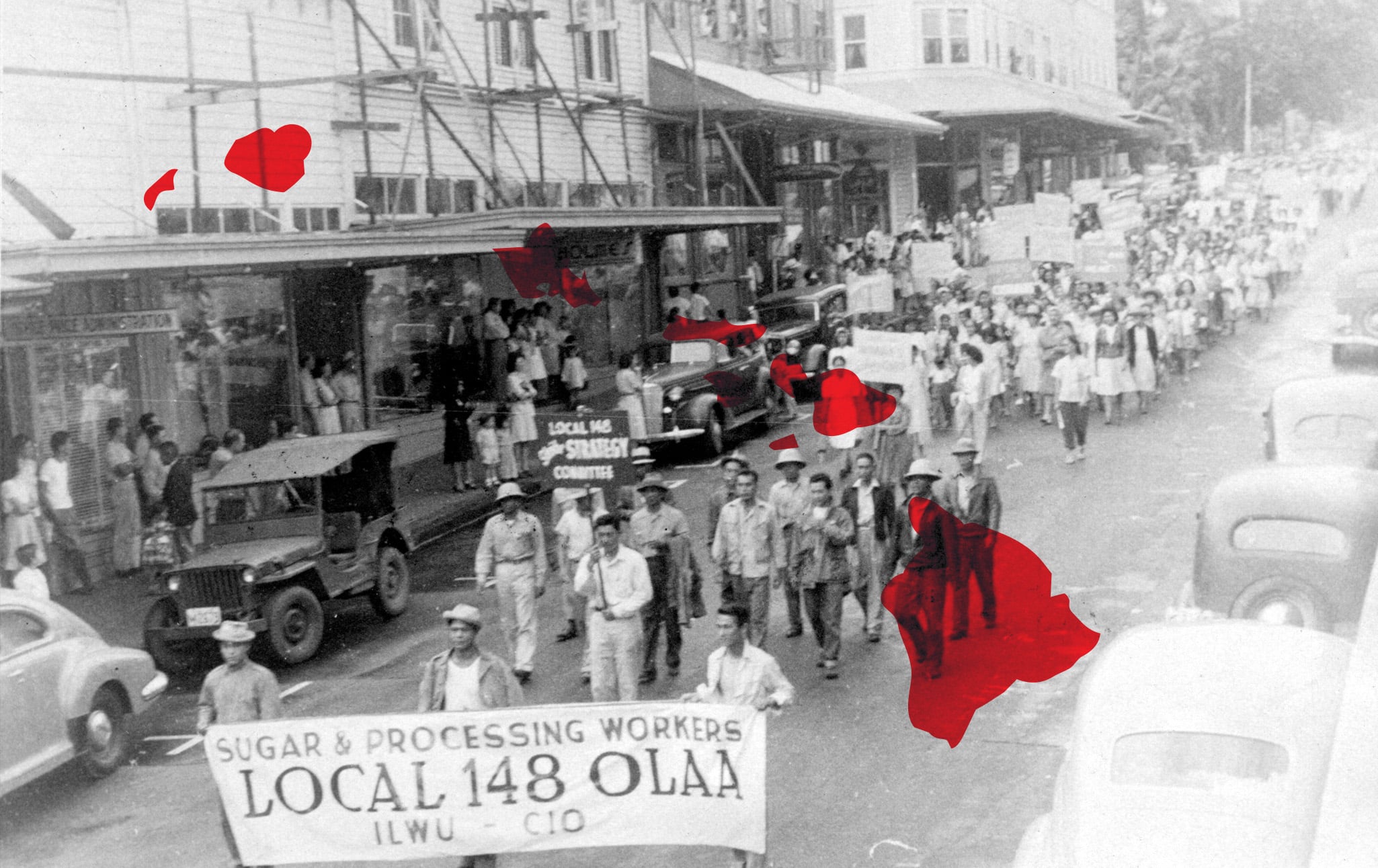
We can learn valuable lessons and tactics from two centuries of labor struggles on the islands.
When people think of union towns, they usually think of steel mills, auto assembly plants, and manufacturing warehouses. Usually, their minds do not wander to wide-stretching beaches, active volcanos, or spirited luaus. But that’s what Hawaiʻi is: a union town, or union state to be more precise. Actually, it’s the most unionized state in the nation. A whopping 24.8 percent of Hawaiʻi’s workforce in 2025 were union members, according to the Bureau of Labor Statistics. Compare that to New York, long thought of as a union stronghold, which takes second place at 21.3 percent.
So, how has Hawaiʻi managed to outrank all of mainland America in the labor movement? To really understand the Hawaiian labor movement, we need to go back long before statehood to ancient Hawaiʻi.
Before the late 1700s, Hawaiʻi had a system of feudal agriculture, with its people raising “taro, sweet potatoes and other crops,” along with pigs and chickens. The maka‘āinana–the commoners—worked for their chiefs for six days a month and paid taxes through goods produced. After the arrival of Captain Cook, the first European to come to the Hawaiian islands, the growing presence of white missionaries shifted the island’s communal lifestyle toward contract work in farming.
In 1835, when Hawaiʻi was ruled by Kalākaua, its last king, the first large-scale sugar plantation opened in the town of Kōloa. This completely shifted lifestyles on the island, with Native Hawaiians going from mainly working to sustain their own lives to laboring daily ten to 12-hour shifts for little reward.
By 1841, some Native Hawaiians had enough, and the island’s first labor strike took place at the Kōloa Plantation in demand of a pay raise. The workers there were being paid in scrip—a substitute for actual currency that could be spent only in a plantation store—instead of cash. “ Everything [was] controlled by the employer,” says Dion Dizon, the director of the University of Hawaiʻi–West Oʻahu’s Center for Labor Education and Research. “It didn’t make for good living conditions.” The eight-day strike was ultimately suppressed, but it served as a foundation for future attempts, and proof of what the working class was capable of.

American and British plantation owners saw this threat and, in an effort to protect their corporate interests, organized themselves into the Royal Hawaiian Agricultural Society. At the same time, the industry ramped up, and the companies soon realized that more laborers were desperately needed. (It didn’t help that, after Cook’s arrival, the native population was decimated due to the arrival of European diseases.)
Plantation owners first brought in workers from China, and then Japan, Korea, Portugal, and the Philippines. The bosses’ plan was simple: divide the labor force up by ethnicity to sow division. But workers found ways to come together, creating whole new languages and dialects to bridge the gap. “Pidgin English was developed because you had all these different people that don’t speak the same language but do work together,” Dizon said.
Around the same time, Hawaiʻi adopted the Masters and Servants Act of 1850. “It was basically a penal system where if [a worker] ran away, they could be forcibly brought back,” explained Dizon. In other words, the act legalized a de facto form of slavery, because it wasn’t criminal to quit one’s job before it. Plantations were overseen by lunas, who controlled and disciplined the laborers with whips and often kept watch on horseback. The image of them is not far off from the slave patrollers of America’s southern plantations.
By the 1880s, the “Big Five” corporations had control of the sugar plantations. These companies were C. Brewer & Co., Castle & Cooke, Alexander and Baldwin, Theo H. Davies, and Hackfeld & Co., which later became American Factors or “AmFac.”. Later on, they would control most of the island’s economic and political activity. They also wielded power over pineapple plantations, utilities, banking, and other major sectors. “ Hawaiʻi essentially lived under an oligarchy,” Dizon said. Of the “Big Five,” three are still in operation, with only C. Brewer and Co. and AmFac having gone out of business.
There were some early acts of unionization before Hawaiʻi’s annexation. In 1857, the Hawaiian Mechanics Benefit Union was chartered, according to the University of Hawaiʻi’s Center for Labor Education & Research. Some years later in 1884, the Typographical Union was formed.
But besides those pre-Annexation moves, Hawaiian unionization didn’t heat up until the 1930s and ’40s. Even after Hawaii became a U.S. territory in 1900, the craft unions—a type of unionization formed around workers who share a similar skill—that formed in the years after struggled to survive due to the reluctance to organize across racial lines.
Labor dynamics shifted after Hawaiʻi became a territory. Suddenly, the island and its government were beholden to the U.S. constitution, which prohibited slavery and involuntary servitude. That meant that many labor contracts were no longer binding, and once word spread, thousands of people walked off the plantations. Some came back days later after celebrating, but many freed workers either went to the mainland, back to their original homelands, or took new jobs in Hawaiʻi. Due to this shift, the plantations began to import even more immigrants to fill these gaps.
In 1909, the unequal treatment of different ethnicities of workers became apparent when pay discrepancies between ethnicities became more widely known. At the time, Japanese workers made up a bulk of the plantations’ workforce, but were at the very bottom of a nationality-based wage hierarchy. So a small group of activists, including the attorney Motoyuki Negoro (who “was unable to practice law in Hawaii because he was not a U.S. citizen”) and the journalist Yasutaro Soga, formed the Japanese Higher Wages Association. Sending out dozens of articles and editorials, they publicized the injustice in Soga’s paper, the Nippu Jiji (which was the oldest Japanese-language newspaper in Hawaiʻi), advocating for better wages and labor conditions. Their rhetoric was often dramatic:
Most of the capitalists of Hawaii are the descendants of missionaries. The wealth that was inherited by these capitalists was not intended to be spent leading a life of luxury and pomp[…] Was it given to them to suck the blood of poor laborers in order they may live in luxury?
All of this led up to a momentous strike, in which about 5,000 Japanese workers downed tools and demanded higher pay.
The plantations immediately hired strikebreakers of different races for a higher wage. The police, too, took action to put down the labor movement, raiding the offices of the Nippu Jiji and putting several organizers in jail for vague charges of conspiracy and “being disorderly persons.” After three months, though, Japanese workers struck a deal and the race-based pay differences ended.
In the years that followed, multi-racial solidarity slowly started to grow among workers. The Oahu sugar strike of 1920 brought Filipino and Japanese plantation workers together to fight for better wages and working conditions. Their actions were heavily influenced by the inflation caused by World War I. While cost-of-living skyrocketed, plantation wages stayed stagnant. The multiracial fight of 1920 did win the groups a pay raise after more than half a year of striking. Housing, sanitation, and water systems saw improvements.
Yet this did not come without many hardships. During the strike, owners evicted strikers from plantation houses, leaving about 12,000 homeless. When the strike ended, many Japanese workers were not taken back. The Spanish flu was raging at the time, and many of those evicted fell ill or even died during the epidemic.
Another turning point was the 1938 Hilo massacre, also known as Bloody Monday. A year prior, the International Longshoremen's and Warehousemen's Union (ILWU) was formed in California, and Hawaiian dockworkers affiliated with the group soon after.
In the months leading up to Bloody Monday, strikes had begun. Workers closed down shops as they demanded equal wages with their counterparts on the West Coast. The strikers learned that on August 1st, a ship of non-union workers was coming in. So the striking longshoremen and their supporters from various other unions and community groups showed up to peacefully protest the arrival, but things escalated quickly. A police force of over 70 officers opened fire on over 200 protestors of varying ethnicities. No one died, but 50 demonstrators were hospitalized, and outrage at the cops’ violence soon translated into support for the growing labor movement.
In the years that followed, organizer Jack Hall became a rising figure in the Hawaiian labor movement. Like Yasutora Soga decades earlier, he wrote countless articles for a radical newspaper called the Voice of Labor, using the mass media to build support for the workers’ cause. He would go on to become a major leader in the ILWU, so much so that he was investigated by the House Un-American Activities Committee in 1951. Years later, many ILWU contracts would either give their workers paid time off for his birthday or death date.
“People with time on their hands and not much else to do really worked hard to organize,” Hall said in an 1966 interview with Edward D. Beechert, who later went on to publish “Working in Hawaii: A Labor History.” “We used to go right into the camps, even though they had trespass laws, and defy them to throw us out. Sometimes they would take you out, but we went back in. Actually, I haven’t been subjected to any violence since before the war, but there was a hell of a lot of it then. There were two occasions when they were out to knock me off on Kauai that have been confirmed by informed sources.”
Making sure organizational meetings were accessible for the diverse workforce was an important strategy. “In those days they had to be conducted in three and sometimes four languages, including two Filipino ones,” Hall said. “You had to have discussion in Japanese and Ilocano, in English for the younger workers, and sometimes still in Visayan.”
In 1946, the ILWU had united various different ethnic groups across the sugar plantations. They organized about 26,000 sugar plantation workers. At the time, about 20 percent of Hawaiʻi’s population worked on these plantations.
“We, of course, enforced multi-racial leadership, irrespective of abilities, which bothered some people, but you can’t survive without multi-racial leadership,” Hall recounted. “We had everybody in the leadership in one fashion or another, and everybody felt a part of it. The employers didn’t think we would survive, but I don’t think they knew their own people.”
The ILWU’s ability to unify a chunk of the workers led them to launch a momentous strike that lasted 79 days and shut down 33 of the 34 plantations, essentially shuttering the sugar industry. The result? Workers won increased wages, established a 46-hour workweek after years of regularly working 10 to 16 hour days, and improved housing conditions and medical care. Plus, it contributed to dismantling the dominance of the Big Five in Hawaiian politics and economics.
The introduction of air travel turned Hawaiʻi into a tourism hotspot, creating a major shift in industries for the islands, which too eventually organized. “[The] majority of our large hotels are organized by UNITE HERE local 5–at least on Oahu,” Dizon said. “And then on the outer islands, a lot are organized by the ILWU local 142.”
What really solidified Hawaiʻi’s stronghold in the labor movement, in Dizon’s eyes, was when the state legislature passed the Hawaii Public Employment Collective Bargaining Law . “That’s when Hawaiʻi actually codified the right for our public sector union or public sector employees to organize,” she said. Hawaiʻi became one of the first states to rule that public-sector workers have a qualified right to strike.

Dizon thinks the Hawaiian labor movement had the momentum needed to win that landmark legislation because of the impact of previous strikes, as well as the mobilization caused by the Hawaii Democratic Revolution of 1954—when around 50 years of electoral dominance by the GOP came to a sudden end—and the establishment of the Center for Labor Education and Research in 1976. ”That was really labor recognizing that in order to stop the bleeding on the ground, they have to take it, upwards to law and policy to make those changes,” she said.
She thinks organizers in other areas of the country trying to push pro-labor legislation could replicate Hawaiian’s success by tapping into their political will to approach legislative challenges even when it’s inconvenient.
In modern times, the Hawaiian labor movement faces many of the same struggles as the rest of the country’s movement. Dizon says that big national issues, like the Janus v. AFSCME decision (which ruled that public sector employees cannot be required to pay union fees) and recent executive orders from the Trump administration have weakened Hawaiʻi's labor movement a tad.
But Dizon is still seeing young people tap into labor as an “engine” to the rest of their social justice endeavors. She thinks labor organizing directs residents on how to better take responsibility for their community–even in indirect ways. “ I think what people sometimes forget is that even while we're out fighting for union members, the gains that we make in labor impact everybody else who are in non-unionized workplaces,” Dizon said.
Like everywhere else in the United States, Hawaiʻi is facing a cost-of-living crisis, and many young people feel like they are being priced out of the islands altogether. That’s where Dizon thinks Hawaiʻi’s rich history of labor organizing can make a difference. From Jack Hall’s insistence on unifying workers of many different races and language communities, to the Japanese workers’ adept use of the media, there are plenty of lessons and tactics that today’s organizers can take from the past. Those early strikes back during plantation days have opened pathways to help young Hawaiian workers realize they don’t have to just make a living, they can make a life by coming together and fighting for it. The same is true for all of us, around the world.

.jpg?width=352&name=Bald_Eagle(2).jpg)
.jpg?width=352&name=Untitled%20design%20(2).jpg)