The male beauty influencer is a living demonstration of the perils of “maximization.”
Here in New Orleans, we just celebrated Mardi Gras, so I’m on a high. Mardi Gras always nourishes my soul. The entire city erupts into a giant party, and it’s not just about boozing, but creative artistic expression. The costumes are stunning—people put so much work into making themselves look beautiful and flamboyant and fascinating. There are elaborate floats, delicious food, joyful music, and people are warm and decent to each other. (Shia LaBeouf did not get the memo.) The day is full of serendipitous, weird, wonderful encounters with strangers. In the morning, a woman came up to me and shouted “Number 14! The cinnamon swirl chose you!” then handed me a (delicious) cinnamon roll with “XIV” written on it in icing. In the afternoon, members of the Louisiana Philharmonic Orchestra came up to me while I was sitting on my porch, and offered me free tickets to the show if I would let them all use my bathroom. Every year, Mardi Gras reminds me of what it means to be human, what makes our species great, and why it’s worth fighting for a livable future.
I couldn’t help but think about the gender-bending, vivacious, rich culture of Mardi Gras when I read about the dark, bland, and sterile (literally, as we shall see) world of 20-year-old “manosphere” influencer Braden Peters, known online as “Clavicular.” Peters, who was recently profiled in the New York Times, calls himself a “looksmaxxer,” which is a comically macho way of saying that he desperately wants to be beautiful. (I’m not a beauty influencer, I’m doing Extreme Guy Stuff To The Max.) He is notable for the horrifying measures he has been willing to take in order to reach his ideal of male attractiveness: he started taking testosterone when he was 14, smashes his bones with a hammer in order to try to refine his jawline, and claims to have smoked crystal meth to give his cheeks a gaunt look. Peters has already rendered himself infertile, by his own admission, and has likely set himself up for a host of future health problems, but he believes it’s worth it to make himself look like a stereotypically handsome man. Which he does, for now, although God only knows how he’s going to deal with aging when it inevitably happens.
Clavicular speaks in an idiosyncratic extremely-online vocabulary, with phrases like “frame mogged” (when someone more muscular stands next to you, making you appear weak in comparison) and “jestermaxx” (to entertain women with humor, which is meant as a pejorative, because in this subculture Real Men lure women through their looks rather than their personalities, which are deliberately terrible). These terms are now spreading across social media in memes and jokes, in ways I find deeply, deeply annoying (although at least I’m not the parent of a teenage boy who won’t stop talking about “jestermaxxing”). The looksmaxxing argot, which has been compared with that of the Droogs in A Clockwork Orange, is becoming so ubiquitous among the online right that the Department of War now claims it is “lethalitymaxxing” and the Department of Homeland Security claims it is “homelandmaxxing.” (The communications departments of federal agencies under Trump appear to be staffed by 19-year-old 4chan Nazis, a fact that has not raised enough concern.)
Now, we might ask: does all of this matter? Is it bad, or merely weird? There may be a few women who see these men with debilitating body dysmorphia and think, now you know how it feels. It used to be that oppressive beauty standards mostly affected women, so perhaps there’s something equalizing about having men feel hopelessly insecure about their figures and resorting to desperate methods to keep fat off. This is certainly a shift. The rise of the male beauty influencer, giving makeover advice, from one angle might seem downright refreshing: let men care about how they look for once! Let them put in some damned effort to please the eye. Don’t take meth, for God’s sake, but to the extent that looksmaxxing means trying to be beautiful, let’s give men their turn at extreme insecurity about their appearance.
Except, of course, that it isn’t good when unobtainable beauty standards are inflicted on women and it’s not any better if they’re inflicted on men as well. It’s unhealthy for so many people to be uncomfortable with who they are and feel they have to torture themselves in order to not be hideous. We should recoil at a world where everyone is encouraged to be dissatisfied with themselves and desperately attempts to achieve a certain set of facial proportions. (Clavicular has all kinds of numbers memorized, like the optimal “midface ratio” and “chin to philtrum” length.)

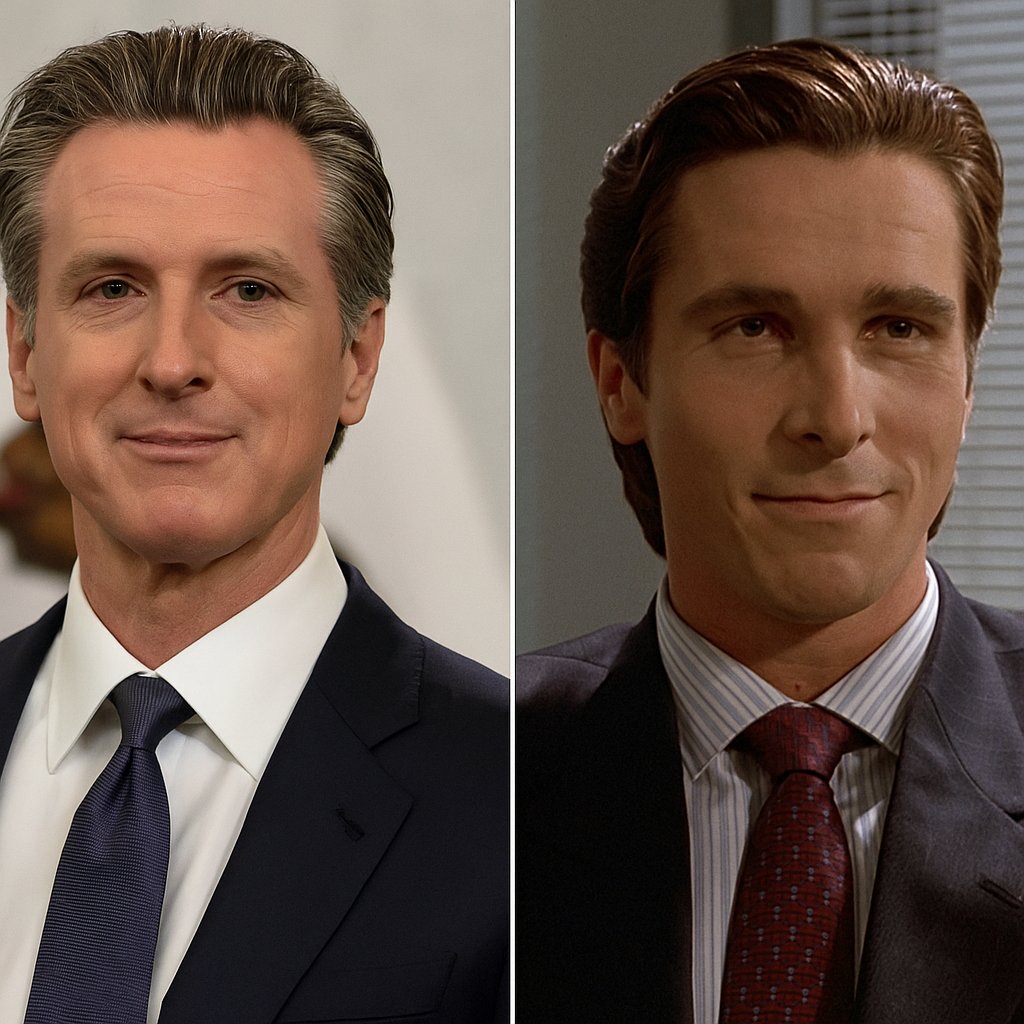
Plus: the culture Clavicular inhabits is deeply misogynistic, treating women as essentially worthless except as a means of affirming male status. There is also something obviously downright eugenic in all of this, and it echoes the Nazi division of the world into ubermenschen and untermenschen. Clavicular has called JD Vance “subhuman” because he is pudgy, and says he would vote for Gavin Newsom instead, because Newsom is handsome. (Personally I have always felt Newsom looks a bit like American Psycho’s Patrick Bateman, a comparison I am far from the only one to have noted—“Even your friends say this,” an interviewer told Newsom.) Clavicular/Peters has purely “lookist” politics, so his preference for Newsom over Vance has nothing to do with policy, about which he knows little. He professes to have no ideology beyond the belief that being beautiful is good and being ugly is bad, and his political ignorance is staggering. In a recent interview with Adam Friedland (why, Adam, why?), he admitted he had never heard of New York City mayor Zohran Mamdani. In a way, I think this is good. I’d rather someone like Peters just be an apolitical himbo, because even if his values might be eugenic, he is unlikely to try to translate them into a political program (one cannot imagine him fighting in a war). If we must have people with such repugnant ideals, we can at least hope they will destroy only themselves and leave others alone.
But the danger of Peters’ influence is that many of his followers may well be more political than he is. The “looksmaxxing” community has absorbed a lot of “incel ideology,” where the world is a dog-eat-dog struggle between men for dominance, women are heartless, and you have to be a “chad” (a handsome douchebag) to get women’s attention. The community is naturally filled with racists who think that white features are the height of beauty, and Peters has been spotted in the cozy company of far right figures like Nick Fuentes and Andrew Tate (with whom he sang Ye’s “Heil Hitler” at a Miami club.) I certainly think the young men drawn into these circles are unlikely to become democratic socialists, for whom the idea of human equality is central and Social Darwinism is anathema. It’s a little hard to take Peters at his word that he's "apolitical,” when his entire ideology is built around eugenics and misogyny and he sings about loving Hitler with Andrew Tate.
The world Clavicular inhabits is dystopian. As the “maxx” term indicates, he is obsessively trying to optimize his looks in a mathematical sense. He uses the term “sexual market value” (SMV) to describe what every man’s goal should be. But get this: he doesn’t even really seem to like sex. Peters admitted to Friedland that sex with him is about “one minute” long, and he ejaculates as quickly as possible because “I gotta get back to work.” The Times reports that he thinks “knowing he could have sex with a woman was in some ways better than the deed itself, which ‘is going to gain me nothing,’” and it’s “a big time saver” to simply not go through with the sex itself. (“Incels” have always seemed misnamed to me, since so many of them actually seem repulsed by the idea of spending time around women.)
Which raises the question: What is all of this for? If “sexual market value” is not about the pleasuring of having sex, what is it for? Well, this is a bit like asking a capitalist why they accumulate so much money if they’re never going to be able to spend it. For the capitalist, after a certain point money is no longer a means toward experiencing actual satisfaction by buying vacations, houses, cars, etc. The amount of money itself, the number on the spreadsheet, is what is to be maximized. It’s more for the sake of more, and is therefore ultimately a meaningless quest.
“Maxxing” anything is a dangerous business. (Except, perhaps, “TJMaxxing,” which can yield remarkable bargains.) When you maximize one quality you necessarily neglect others. To truly maximize my daily writing output, I would have to neglect my health, social relationships, etc. To maximize the cleanliness of my house, I would have to become an obsessive for whom removing every last fleck of dirt was a full-time job. Capitalism is a deadly system precisely because it tries to maximize profit, even if doing so destroys the long-term viability of the planet, which is why sustainability economists like Kate Raworth have developed economic measures that focus on achieving healthy balances of various socially desirable ends, rather than maximizing one. The thought experiment of the “paperclip maximizer” is designed to show how, if an intelligent system were given the goal of maximizing a certain output (say, the production of paperclips), it would wreck the entire Earth and exterminate humanity in order to achieve its narrow goal.
A functional, healthy human life focuses on balance rather than maximization. It’s okay to care about your appearance (I’m a man who loves clothes), but to care only about your appearance turns one into a sociopath and impoverishes one’s existence. In fact, it’s remarkable how Peters seems to have been destroyed by his obsessive quest. He refers to his life as a “fucking horror story,” and it’s striking watching videos of him how few social skills he has. He is awkward with women—the Times reports on a painful “date” he had on camera—and his obsession with beauty means he knows absolutely nothing about anything. It’s not just politics. In his interview with Friedland, Peters reveals he doesn’t know who Bruce Springsteen is, can’t name a favorite movie, has never seen (or seemingly heard of) Seinfeld, and doesn’t even know what type of dog he has. He seems deathly boring (a commenter on YouTube said he could stand to try “personalitymaxxing” for a while), has no interest in knowledge (he was kicked out of college after three weeks for having steroids in his dorm room), has no plans to go back, and says young men should take their student loan money and spend it on plastic surgery). He has little respect for the conventional virtues like kindness, as this exchange with Friedland showed:
FRIEDLAND
Where do you rank male beauty on the kind of scale of what's important?
PETERS
The highest.
FRIEDLAND
Like higher than kindness or something?
PETERS
Yeah.
FRIEDLAND
Really? And why is that?
PETERS
Well, because these things are going to be perceived according to the physical, right? So all the intangible things, like being kind, or, you know, being funny, that's all going to be haloed by your attractiveness. So there's no point in really valuing them as separate things when they're all kind of interconnected.
FRIEDLAND
Well, like Mother Teresa, she wasn't quite a looker, but she's famous for her kindness. She didn't need a baseline attractiveness. She was kind.
PETERS
Well, nobody gives a shit about Mother Teresa.
He strikes me as sociopathic, and also incapable of reasoning—even if he was right that people’s perceptions of your other virtues were modified by your attractiveness, a dubious claim, that would still not mean there was “no point” in valuing them. But most importantly, it all seems such a sad, empty life. The sex is bad, you torture yourself, and what do you get? I mean, if you’re Peters, you get a lot of money (he earns $100,000 a month as a streamer), but you could not pay me that much money to smash my jaw with a hammer and mess myself up with steroids.
I think what we see in Clavicular is an extreme example of what feminists were saying all along about how toxic masculinity is bad not just for women, but for men as well. When men feel like they have to be Masculine, they practice unhealthy behaviors that make their relationships bad and make them unhappy themselves. I also think we’re seeing here the long-term psychological effects of the pandemic era—Peters began his quest to “ascend” (his word for becoming more beautiful) during the Covid lockdown, when he was spending 14 hours a day online. Clavicular is what happens in a society where normal human relations have broken down and many young men are desperately alone and in search of meaning. As Slate’s David Mack writes, he “has come to embody, in a sort of terrifying yet fascinating way, what the internet has done to some young men in 2026.”
I said earlier of Mardi Gras that it reminds me of what it means to be human. Peters shows me what it means to not be human. Of course, in a way that’s an odd thing to say, since Peters obviously is human. But he is shedding the qualities that give human life its richness and meaning. He is turning himself into a perfect, featureless department-store mannequin, without culture, without love, without a future. This is what the masculine ideal can do to people.
Fortunately, there is an alternative. I see it every year at Mardi Gras. We can embrace diversity of appearance, without sacrificing an appreciation for beauty and aesthetics. We can love each other as we are, while still spending time doing our makeup. We can have a healthy relationship with our bodies, being proud of how we were made while wanting to look our best. I say, if you really want to “looksmaxx,” you shouldn’t aspire to bash your bones and look like Peters. Instead, you should try to look like this:

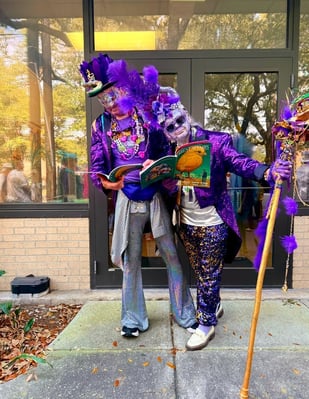

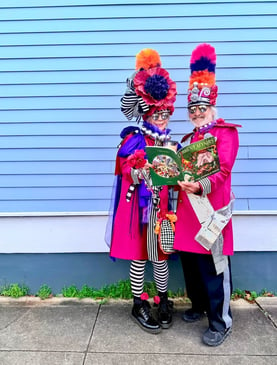
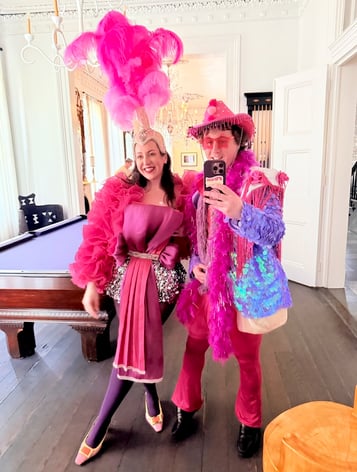
Come on, how’s anyone ever going to look better than that?